By GearDeep Editorial · Updated
Amazon Affiliate Disclosure: As an Amazon Associate I earn from qualifying purchases. This comes at no extra cost to you. How affiliate links work.
The best scuba fins match your footwear, kicking style and usual entries. A fin that feels manageable in warm water may be the wrong choice over thick boots or during a long shore entry. This guide compares six distinct designs, with practical reasons to choose an open-heel or full-foot model and the fit checks that matter before buying.
The short answer
Quick Verdict
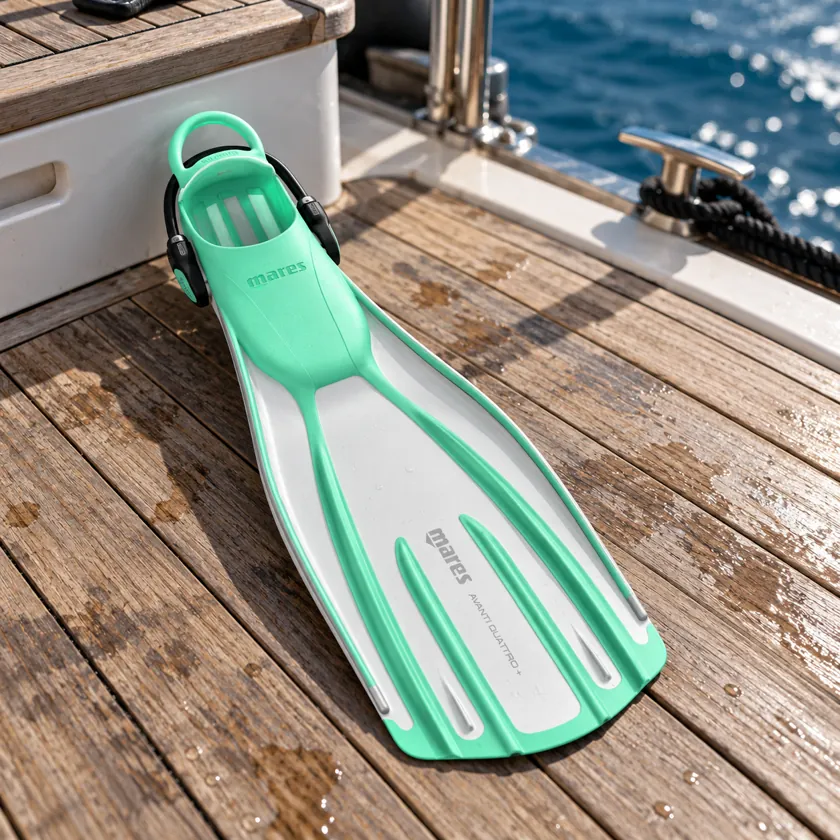
Our top pick is the Mares Avanti Quattro+ for divers who want an all-round open-heel fin to use with dive boots.
- Choose the SCUBAPRO GO Sport when boot-compatible travel packing is the priority.
- Try the Cressi Reaction Pro for a full-foot warm-water setup.
- Compare the Cressi Reaction EBS if its blade response and bungee arrangement suit your kick.
For our selection process, read How We Research.
On this page
Best Scuba Fins: Quick Comparison
Compare the features that affect your purchase, then check the selected listing for the current price, version and package contents.
| Model | Best For | Footwear & Design | Main Purchase Check | Price / Where to Buy |
|---|---|---|---|---|
 Mares Avanti Quattro+ | Open-Heel Starting Point | Open heel | Check boot-pocket fit | Check price on Amazon |
 Cressi Reaction EBS | Alternative Bungee-Strap Fit | Open heel | Confirm stiffness preference | Check price on Amazon |
 Cressi Reaction Pro | Full-Foot Alternative | Full foot | Precise foot-pocket fit | Check price on Amazon |
 SCUBAPRO GO Sport | Boot-Fit Travel Option | Open heel | Distinguish standard, Gorilla and Travel versions | Check price on Amazon |
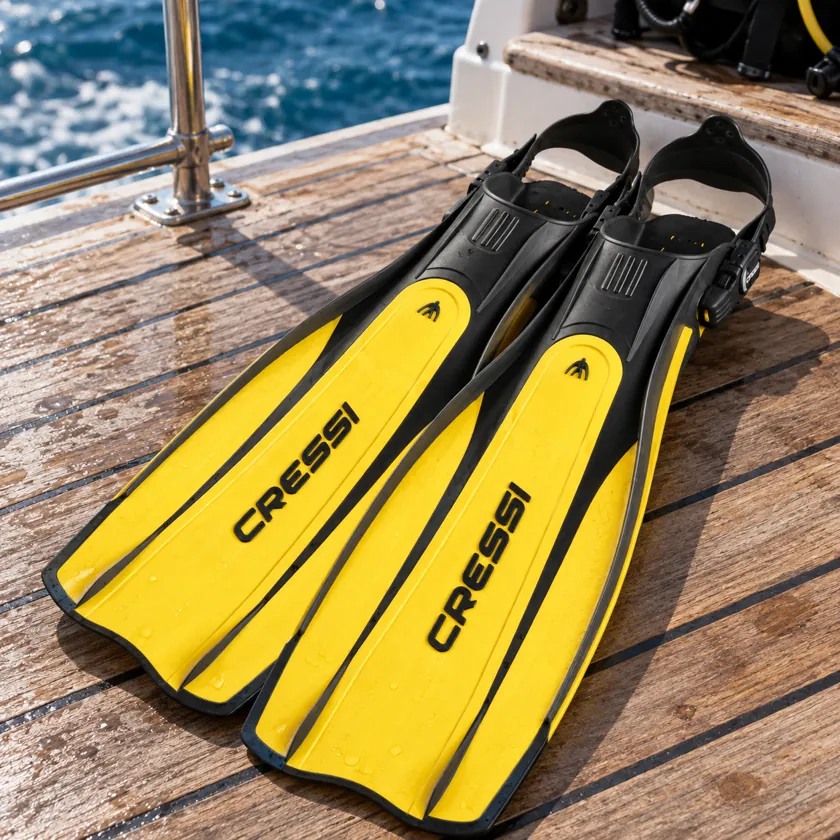 Cressi Pro Light | Traditional Open-Heel Alternative | Open heel | Check boot fit and strap compatibility | Check price on Amazon |
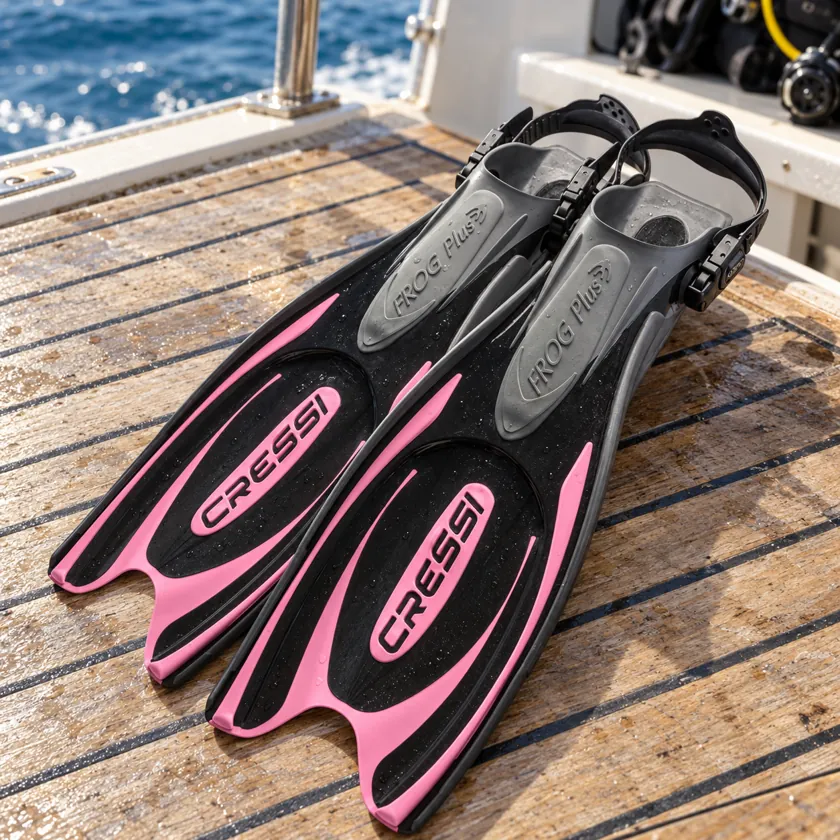 Cressi Frog Plus | Additional Open-Heel Fit to Try | Open heel | Confirm model and heel strap | Check price on Amazon |
1. Mares Avanti Quattro+ — Best Overall Open-Heel Starting Point
The Avanti Quattro+ is the first fin we would try for an all-round boot-compatible setup. Its four-channel blade and bungee strap give you a straightforward open-heel design to assess against your own footwear and kicking style.
Key Features
- Open-heel pocket for suitable dive boots
- Four-channel blade design
- Bungee heel strap
- Anatomical foot pocket
- Stabilizing blade ribs
Why It’s Our #1 Pick
The Avanti Quattro+ takes our top position because it combines a familiar open-heel layout with a four-channel blade and a bungee heel strap. That is a useful starting point for a recreational diver who already wears boots and wants one fin to compare across boat and shore-diving routines. The strap avoids the repeated adjustment of a conventional buckle, provided its tension suits the boot.
Its strongest case is that the essential buying decisions are easy to identify: how the boot fills the anatomical pocket, whether the bungee holds the heel comfortably and whether the blade response suits your legs. Those are more useful reasons for a recommendation than claiming that one fin makes every diver faster.
Choose another design when your priorities differ. The GO Sport is worth a direct packing comparison for travel, and the Reaction Pro suits a full-foot arrangement. The Quattro+ remains our all-round boot-compatible starting point, subject to a proper fitting rather than a promise of universal comfort.
Pros
- Bungee retention reduces routine buckle adjustment
- Clear open-heel option for a boot-based setup
- Four-channel blade offers a distinct response to compare
Cons
- Bungee tension must suit the selected boot
- Blade effort remains individual
- Larger sizes need a realistic luggage check
Who Should Buy It?
Choose it as an all-round fitting candidate if you already prefer open-heel fins and dive boots, and its blade response remains comfortable during your normal kick.
2. Cressi Reaction EBS — Best Alternative Bungee-Strap Fit
The Reaction EBS is the open-heel alternative to try when the Mares pocket or blade response does not suit you. It combines a polypropylene blade, three-material construction and Cressi’s elastic-bungee heel system.
Key Features
- Open-heel configuration
- Three-material construction
- Polypropylene blade
- Elastic Bungee System heel retention
Why It Makes the Shortlist
This model is a candidate for divers who want an open-heel configuration with an elastic-bungee retention system and who are comparing the feel of different blade constructions. The published polypropylene blade and multi-material construction describe the design, but they do not establish a measured efficiency advantage over other fins. Trying the model with your regular boots is more meaningful than assuming its name predicts flexibility or swimming effort.
Look closely at heel tension, the space at the toes, the comfort of the top of the foot pocket and ease of removal. If you frequently dive in gloves, assess whether you can grasp and reposition the heel strap. A potential disadvantage of relying on any elastic strap is that the fit needs to match the combined dimensions of fin pocket and boot. Confirm the exact variant and regional replacement-part availability.
Pros
- A different pocket and blade response to compare
- Bungee heel system
- Suitable for a supported boot-based arrangement
Cons
- Bungee fit still depends on boot shape
- Blade preference needs a personal trial
- Reaction Pro is a separate full-foot model
Who Should Buy It?
Try the Reaction EBS alongside the Quattro+ when you want bungee retention but need to compare a different pocket shape and blade response.
3. Cressi Reaction Pro — Best Full-Foot Alternative
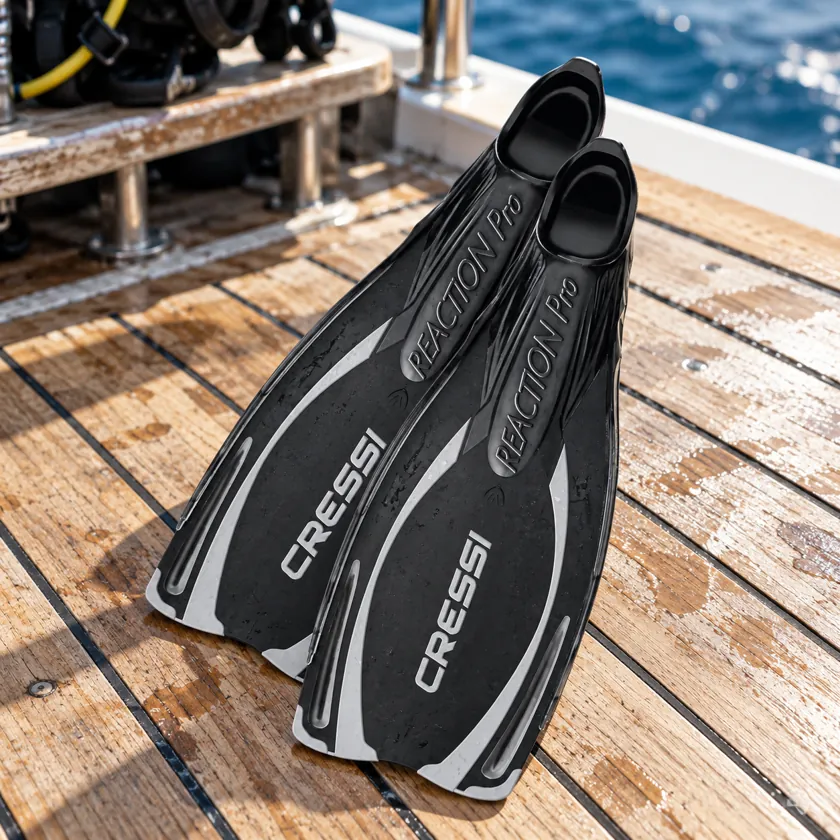
The Reaction Pro changes the footwear decision rather than simply changing the strap. Its closed full-foot pocket is the option to consider for suitable warm-water diving when you do not need the open-heel boot arrangement.
Key Features
- Full-foot pocket
- Polypropylene blade
- Thermo-rubber foot pocket
- Rubber sole designed for surface grip
Why It Makes the Shortlist
The defining reason to shortlist this fin is its full-foot construction. Divers who usually enter warm water directly from boats may prefer a simple fit without substantial dive boots. This convenience disappears if the foot pocket rubs or if the diver needs protective footwear for the site. Compare the manufacturer’s sizing guidance against the dimensions of your foot, not merely your usual shoe size.
Because a full-foot fin relies on the pocket itself to retain the heel, precise fit is especially important. Watch for pressure across the toes, rubbing behind the heel and sliding during movement. Its rubberized sole area should not be interpreted as approval for walking across hazardous terrain. If you frequently alternate between rocky shore entries and boat dives, an open-heel boot-compatible system may be more practical. The fin should be tried in controlled conditions before a demanding dive.
Pros
- A distinct full-foot option
- No separate heel-strap adjustment
- Useful when the entry and exposure system suit the pocket
Cons
- Precise foot-pocket sizing matters
- Protective boots may not fit
- Less suitable where the entry requires different footwear
Who Should Buy It?
Choose the Reaction Pro when a full-foot setup fits both your feet and the entry conditions. Keep an open-heel design on the shortlist when protective boots are essential.
4. SCUBAPRO GO Sport — Best Boot-Fit Travel Option
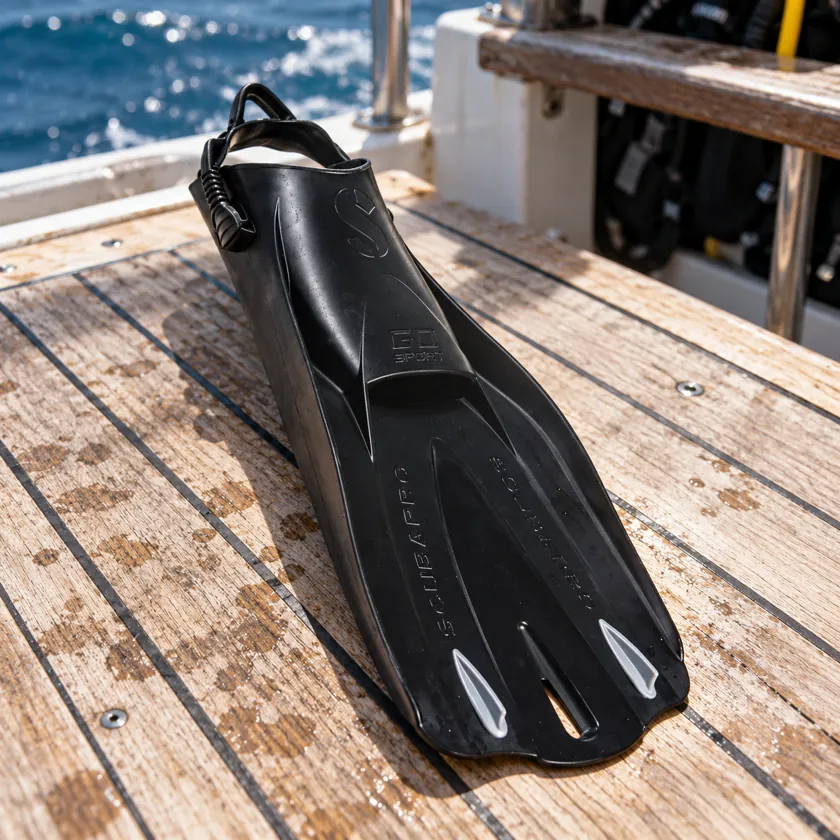
The standard GO Sport is the travel-focused candidate for divers who still want a boot-fit pocket. Its Monprene construction, replaceable bungee and removable skegs give it a different configuration from the Cressi and Mares designs.
Key Features
- Open-heel boot-fit pocket
- Monprene construction
- Replaceable bungee heel strap
- Removable skegs
Why It Makes the Shortlist
The GO Sport is being considered as an open-heel option for divers who combine travel with boot-based diving. The manufacturer’s current product documentation identifies the boot-fit pocket, bungee retention and skeg mounting points. Those details are useful starting points for model identification, but a current buyer must confirm that the actual retail variant matches the listed version. This is particularly important where similarly named GO-family fins are sold alongside one another.
Compare packed length and weight in your own size rather than relying on the word travel. Check how your existing boots seat in the foot pocket and whether heel retention remains secure when moving your ankles. Inspect any removable components and whether compatible replacements are supported. If the vendor does not clearly identify the model version, request precise confirmation or choose a better-listed listing.
Pros
- Boot-compatible travel design
- Replaceable heel retention
- Removable skegs
Cons
- GO Travel and Gorilla are different models
- Actual packed size depends on fin size
- Pocket fit still needs the intended boot
Who Should Buy It?
Start here when travel packing is a recurring problem and you want to retain dive boots. Compare the packed fins and pocket fit before choosing the travel label alone.
5. Cressi Pro Light — Best Traditional Open-Heel Alternative
The Pro Light belongs on the shortlist if you prefer a traditional adjustable open-heel layout. Its polypropylene blade and soft elastomer pocket offer another combination to try with the boots you already own.
Key Features
- Open-heel layout
- Polypropylene blade
- Soft elastomer foot pocket
- Protective elastomer elements
Why It Makes the Shortlist
The Cressi Pro Light is a candidate for divers considering a traditional open-heel fin with a blade intended for scuba use. As with any open-heel design, its fit must be checked using the diver’s own boots. Its flexible response, blade geometry and size should be examined alongside competing products rather than inferred from promotional descriptions.
Confirm whether the seller’s version includes the expected heel straps and whether replacements are available. Check that your boots fit deeply enough into the pocket and that the heel strap does not shift. Compare the full fin dimensions and weight if you travel frequently. Avoid assuming a listing that says ‘Pro Light’ represents the same product without inspecting the manufacturer and part number.
Pros
- Traditional adjustable-strap arrangement
- Another pocket shape to compare
- Straightforward blade and pocket materials
Cons
- Optional EBS parts are not automatically included
- Replacement straps must match the model
- Blade response and boot fit are individual
Who Should Buy It?
Choose the Pro Light when you prefer its adjustable heel arrangement and find the pocket comfortable with your actual boots, rather than assuming a different Cressi strap will fit.
6. Cressi Frog Plus — Best Additional Open-Heel Fit to Try
The Frog Plus is worth a fitting when the other open-heel candidates create pressure or do not suit your preferred blade feel. Its three-material construction and below-blade pocket position give it a distinct layout within the Cressi range.
Key Features
- Open-heel design
- Three-material construction
- Below-blade foot-pocket position
- Model-specific heel strap and buckle arrangement
Why It Makes the Shortlist
The Cressi Frog Plus is an additional design option for scuba divers evaluating an open-heel alternative. Its suitability depends on boot-pocket fit, blade feel and diver technique. A product can be popular with one group of divers while being uncomfortable for somebody with a different swimming style or foot shape. It should be compared in controlled water if possible.
Distinguish the Frog Plus from similarly named Frog models. Verify manufacturer product identification, sizing guidance, heel strap design and a return policy. Do not infer that retailer photos and specifications are current solely because an old listing remains indexed in search results.
Pros
- A different pocket and blade configuration
- Useful alternative within the open-heel group
- Multiple size and strap versions to investigate
Cons
- Confirm the actual supplied strap variation
- The pocket still needs a boot fitting
- Low-effort claims do not predict every diver’s experience
Who Should Buy It?
Try the Frog Plus when you want another open-heel pocket and blade layout to compare. Identify the supplied strap before ordering accessories or spare parts.
How to Choose Scuba Fins
Start with the footwear and entry conditions you use most often. Then compare pocket fit, heel retention and the blade response you can control comfortably. A reputation for power or easy kicking is less useful than a fin that stays secure and works with your technique throughout the dive.
Who this guide is designed for
Scuba fins should be selected as part of a complete diving setup. A diver learning fundamental skills in relatively calm water may care most about a predictable blade, a comfortable pocket and straightforward adjustment. Someone who regularly enters from a rocky shore may place more weight on compatibility with protective dive boots. A traveler may prioritize packing dimensions, but should not accept painful fit to reduce luggage weight. A diver who photographs marine life may want controlled movements near the bottom rather than a fin chosen mainly for strong straight-line kicking. Different priorities can lead to different choices among the same six models. Popularity can identify a model to try, but fit and control should decide the purchase. The right starting point is your training, common sites, footwear and comfort. Equipment used in specialized conditions should be selected with appropriate instruction.
Choosing between open-heel and full-foot fins
An open-heel fin secures around the heel using a strap. Depending on the design, it may be intended for dive boots and can be convenient when footwear is needed for warmth or walking at a dive site. A full-foot fin encloses the heel and commonly works without a substantial boot. Neither arrangement tells you everything about the blade or propulsion. Full-foot fins can feel convenient on warm-water boat trips but may be less suitable for rough shore entries. Open-heel fins involve checking two components together: the fin and the footwear. When trying a fin, wear the boots or socks you actually plan to dive in. Check that the heel is stable without compression, the toes have room and the strap cannot slide off with ordinary movement. If your foot is only retained by extreme strap tension, the pocket may not suit you. Our separate guide to open-heel and full-foot fins explores these trade-offs in more detail.
What blade stiffness changes—and what it does not
Fin blades vary in material, geometry and resistance to bending. A stiffer blade can feel responsive to one diver yet tiring to another, while a flexible design may be comfortable for sustained movement but feel different during maneuvering. There is no reliable single stiffness ranking across these six models based only on promotional descriptions. Manufacturers do not always measure or present stiffness using the same method. Some fins use channels or rails to guide water movement, while others use broad uninterrupted surfaces or material combinations. Those features are helpful to identify a model, but they do not establish a universal speed or efficiency advantage. Think about how you move in the water, how much effort you can comfortably sustain and whether you have an opportunity to compare fins under similar conditions. An appropriately sized fin that you can control is more valuable than an impressive-sounding blade design that causes discomfort.
Flutter kicks, frog kicks and controlled maneuvering
Different kicking techniques ask different things of a fin. A flutter kick generally cycles the legs alternately, while a frog kick emphasizes a different movement and can help some divers limit downward disturbance when performed correctly. Turning, backing away and maintaining position may use additional learned techniques. A model suitable for ordinary recreational flutter kicking is not necessarily equally comfortable for every other movement. Avoid assuming that one blade shape automatically makes someone a better diver. Technique, body positioning, buoyancy control, exposure protection and cylinder configuration also influence how efficiently a person moves. If you mostly dive near delicate reefs or silt, training in controlled finning and buoyancy is essential regardless of the chosen product. Test unfamiliar fins in appropriate conditions before using them on a demanding dive or above sensitive habitat.
Sizing and foot-pocket geometry
A listed size is not a promise of fit. Foot pockets vary in width, toe depth, arch shape and heel clearance. Different manufacturers may use overlapping size labels that do not represent interchangeable dimensions. Open-heel fins are especially dependent on the thickness and shape of the boots placed inside them. A boot with a thick sole may prevent the foot from seating fully even when the printed shoe size falls within the nominal range. Full-foot fins present a different issue: the material must be secure enough to avoid slipping without restricting the toes or rubbing the ankle. Try the fins in a shop when possible and walk through the manufacturer’s actual size chart. If buying online, consider whether the seller permits a dry fit check and straightforward returns. If you already own boots, their exact model can be just as important as your shoe size.
Bungee straps, conventional buckles and replacements
An elastic-bungee strap can reduce the need for repeated manual adjustment, while some conventional straps use buckles that allow specific fit changes. Both approaches can work well when properly sized and maintained. Check the release operation before a trip, particularly if you dive wearing gloves. A strap should settle on the heel without twisting or creating an uncomfortable pressure point. Verify whether the model includes the pictured strap, whether replacement parts are sold and whether similarly named variants use different mounting hardware. A fin without a functioning strap may not be safely usable, so replacement availability matters. Never improvise a repair with unapproved parts when the manufacturer requires a dedicated component. Inspect attachment posts, straps and buckles before each dive, and follow a qualified professional’s direction when a problem cannot be resolved confidently.
How much should travel weight matter?
Travel-friendly marketing can describe shorter blades, lighter materials or compact construction, but those claims should be assessed using published dimensions for the exact size. Large fins may extend diagonally across a suitcase, and a set of boots can add meaningful bulk even when the fins themselves seem compact. Compare the whole packing system, including a protective gear bag, wet equipment storage and whether you will transport other bulky items. If the product listing does not clearly state whether its weight is per fin or per pair, do not assume a particular figure. Excessive focus on packed size can push a buyer toward a design that does not fit well. Your actual diving needs remain the main decision factor. A comfortable, familiar model can justify some luggage space, while a compact model can be an appropriate compromise if its fit and control are still satisfactory.
Cold-water and shore-diving considerations
Water temperature affects exposure protection and may influence fin selection through your footwear. Cold-water divers often use protective boots that need a suitable open-heel pocket. The appropriate boot depends on the rest of the exposure system and should be discussed with an instructor or relevant dive professional. Rocky entries create another reason to wear sturdy footwear before entering the water. Fins are not ordinary walking shoes; transporting them to a safe entry point is usually more practical than attempting to walk a long distance while wearing them. At the exit, consider whether you can safely remove and manage fins under the expected conditions. Procedures depend on site, training and operator requirements. Do not use a product review to decide how to conduct an entry or exit beyond your experience.
Environmental control and contact with the bottom
Scuba divers have a responsibility to avoid damaging the environment they visit. Fin size and design can affect how a diver perceives their movements, but equipment alone does not guarantee good control. Training in neutral buoyancy, trim and non-contact finning is far more important than a manufacturer’s efficiency claim. A careless kick can disturb silt or fragile marine life regardless of whether the fin is expensive or inexpensive. When researching models, ask how comfortable they feel for deliberate, controlled movement and how the blade behaves at modest effort. Keep enough distance from reefs and wreck surfaces to avoid contact. This is particularly important while adapting to new fins because familiar movement patterns may need adjustment. Select sites and conditions appropriate for practicing unfamiliar equipment before attempting precision maneuvers near sensitive areas.
A careful first-water trial
A dry fit can reject an obviously unsuitable pair, but the first in-water experience remains important. Arrange any trial in conditions consistent with your training and the site’s rules. Begin by confirming that the fins stay on securely and do not create pressure points. Swim at a relaxed pace using the techniques you have learned. Pay attention to repeated heel movement, rubbing, cramping or unusual effort rather than judging only by an initial sense of speed. Practice gentle direction changes and controlled positioning if appropriate to your certification and supervision. If the fin feels uncomfortable, stop and reassess sizing or design. Do not force yourself through a painful trial on the assumption that an uncomfortable foot pocket will eventually improve. Avoid making a demanding current dive, deep dive or overhead environment your first experiment with unfamiliar fins.
Durability and routine maintenance
Fins are exposed to sun, saltwater, sand, transport loads and repeated bending. Inspect the blades for cracks, unusual distortion or damaged edges. Pay particular attention to strap attachments and moving buckles, which can collect grit or experience wear. Follow the manufacturer’s rinse and cleaning instructions rather than using strong household chemicals. After diving, let the fins dry appropriately before storage and avoid stacking heavy gear where it can distort the foot pockets or blades. A damaged part may be replaceable, but replacement components should be compatible with the exact fin model. Keep a record of product model and size so you can obtain the correct part. Fin longevity depends on handling, frequency of use and storage conditions; a marketing claim about advanced materials cannot replace regular inspection.
Warranty, spare parts and seller support
Warranty terms vary by manufacturer, region and seller. Check the manufacturer warranty documentation and determine whether a particular seller qualifies for coverage in your country. Returns are separate from warranty service: a marketplace return window may be short, and underwater use can affect eligibility. Consider the availability of replacement straps and buckles before choosing a model for frequent travel. An appealing price is less attractive when replacement parts are hard to source or the seller cannot explain exactly which variant is supplied. Do not assume a brand’s warranty applies uniformly to every marketplace country. Keep your purchase documentation, product identification and correspondence if you need service. Confirm coverage for the exact seller and your country before paying.
Are premium fins worth the money?
A higher purchase price may reflect construction, hardware, styling, brand support or a specialized application. It does not prove better underwater results for a particular diver. A lower-priced fin that fits properly and allows comfortable movement can be the wiser purchase. Conversely, paying more for a strap system you can operate comfortably or a foot pocket that solves a persistent problem may be worthwhile. Start with the functional requirements you cannot compromise: compatible footwear, proper fit, reliable retention and suitable behavior with your learned kick. Then compare optional features and total ownership cost, including boots and potential replacement parts. If two fins both meet your needs, value and availability can decide between them. Compare the total current cost of suitable options, including any boots and replacement parts you need.
Questions to ask before placing an order
What is the exact manufacturer model? Is this an open-heel or full-foot version? Which boots, if any, are recommended? Does the selected product variation match the photograph and description? Does the manufacturer’s size chart support my foot or boot dimensions? Are replacement straps available? Can I find care instructions for this precise model? How large is it when packed, and is the published weight per piece or per pair? Can I return an unused pair after a dry fit? Is the seller offering an authentic product in the relevant regional marketplace? These questions take time, but they catch mistakes that promotional rankings routinely miss. If one answer remains uncertain, verify it before treating the fin as a recommended purchase.
Final buying framework
Choose the fin category that matches your usual footwear and entry conditions. Narrow the list by foot-pocket compatibility, secure retention and the kind of maneuvering you normally practice. Compare blade design without assuming that technical labels prove superiority. Check weight and dimensions if you fly frequently, and verify strap replacement availability if you use your equipment often. Try the product with your actual boots or socks and, where available, test it in an appropriate controlled environment. Only after these steps should price and retailer availability determine the purchase. Treat these six picks as a fitting shortlist.
The three comparisons that narrow this shortlist
Compare the Reaction EBS with the Reaction Pro when deciding whether to keep a boot-based system. They share a family name but have different retention arrangements. The EBS is an open-heel design; the Pro encloses the heel. Buying the Pro because a familiar Reaction EBS fit well over boots can therefore be an expensive mistake. Ask a shop to identify the configuration, then use the correct size chart for that configuration. Similar names do not establish interchangeable foot pockets.
Compare the Avanti Quattro+ with the GO Sport when luggage space is a deciding factor. Mares documents four channels and an anatomical open-heel pocket; SCUBAPRO emphasizes a boot-fit Monprene design with skeg attachment points. Use those differences to decide what to try. Place the actual sizes alongside your luggage, confirm whether your boots seat properly, and decide whether the retention hardware suits your hands. Neither a channel count nor the word travel replaces those checks.
Compare the Pro Light with the Frog Plus when evaluating Cressi’s conventional open-heel choices. The Pro Light documentation identifies a polypropylene blade and soft elastomer foot and protective sections. The Frog Plus documentation describes three materials, a below-blade foot pocket, decreasing blade thickness and rotating buckles. These construction differences can guide a trial, but published marketing does not establish a shared stiffness scale. A useful demonstration involves using the same boots and the same relaxed swimming task with both models, subject to the shop’s trial terms.
Build a useful fit record
Take a note of the fin size, boot model, boot size and how the pocket feels across the instep. Record any heel movement rather than writing only comfortable or uncomfortable. Include whether a thick sole prevents the boot from seating fully and whether the strap can be grasped while wearing your normal gloves. These observations make a second fitting more productive and stop you attributing every problem to blade stiffness.
When comparing two pairs, change one variable at a time. A different boot, a looser strap and another blade all changed together tell you very little about which change helped. A dry fitting can establish obvious pressure or retention problems; a permitted, controlled water trial addresses different questions. Keep the shop’s return conditions clear before using a new pair in water. A worn product may be treated differently from a dry-tried product, regardless of whether it eventually suits you.
Frequently Asked Questions
Which Scuba Fin Should a Beginner Try First?
For a beginner using dive boots, the Mares Avanti Quattro+ is our first fitting candidate. It has a familiar open-heel layout and a bungee strap, but the pocket still needs to fit the actual boot. Try a comparable alternative if the blade feels tiring or the heel tension is uncomfortable; a popular model is not a substitute for an individual fit.
Are Open-Heel or Full-Foot Fins Better for Scuba Diving?
Open-heel fins accommodate suitable dive boots and can make sense for colder water or shore entries that need protective footwear. Full-foot fins suit a different warm-water routine when their pockets fit and the entry allows that arrangement. Decide from footwear, temperature and entry conditions rather than assuming one heel type is always more professional.
Can I Use My Shoe Size to Choose Dive Fins?
Use the brand’s size chart to start, then try the actual boot or foot in the pocket. Shoe size does not describe boot thickness, sole width or the shape of the instep. The heel retention should hold the fin without excessive pressure, while the toes and sides remain comfortable through normal movement.
Is the GO Sport the Same Fin as the GO Travel?
No. The standard GO Sport has a boot-fit pocket, replaceable bungee strap and removable skegs. GO Travel and GO Sport Gorilla are separate designs with different intended footwear or blade characteristics. Match the exact product name before using a sizing chart or ordering replacement parts.
Do More Expensive Fins Always Make Diving Easier?
A higher price does not establish a better fit or less effort for a particular diver. Blade stiffness, pocket geometry, leg strength and technique all affect how a fin feels. Spend on a design that solves a real problem, such as an uncomfortable heel strap or unsuitable footwear fit, rather than buying a performance claim alone.
What Should I Check Before Travelling with New Fins?
Confirm the supplied straps, buckle parts and size, then try the fins with the footwear you will take. Check how they fit in the bag without bending or loading the blades against heavy equipment. Allow time for an appropriate water trial and obtain any model-specific spare parts your travel plan requires.
Our recommendation
Final Verdict
Start with the Mares Avanti Quattro+ if you want an all-round open-heel fin and already dive in boots. Compare the Cressi Reaction EBS when you prefer its blade response, and the GO Sport when travel packing and a boot-fit pocket matter most.
,The Reaction Pro is the full-foot alternative for suitable warm-water use. The Pro Light and Frog Plus provide additional open-heel fits to try. Choose the pocket, heel retention and blade feel that work together with your equipment, then practice the combination before a demanding dive.
Specifications and Manuals
For model details, see Mares Avanti Quattro+ specifications, Cressi Reaction EBS specifications, Cressi Reaction Pro specifications, SCUBAPRO GO Sport specifications, Cressi Pro Light specifications, Cressi Frog Plus specifications.
About the author
Robert
Robert bohat acha bacha hay