By GearDeep Editorial · Updated
Amazon Affiliate Disclosure: As an Amazon Associate I earn from qualifying purchases. This comes at no extra cost to you. How affiliate links work.
The best scuba masks seal comfortably on your face and give you the vision you need with your normal diving equipment. A broad single window, interchangeable corrective lenses or a frameless design can each be useful, but none replaces a fitting. This guide compares six masks and explains which differences are worth considering before you choose.
The short answer
Quick Verdict
The TUSA Freedom HD M1001 is our first fitting candidate for divers who want a single window and plenty of strap adjustment.
- For supported corrective-lens options, compare the TUSA Freedom Ceos and SCUBAPRO Zoom.
- Try the Hollis M1 if a frameless single-window design appeals.
For our selection process, read How We Research.
On this page
Best Scuba Masks: Quick Comparison
Compare the features that affect your purchase, then check the selected listing for the current price, version and package contents.
| Model | Best For | Lens Design | Main Purchase Check | Price / Where to Buy |
|---|---|---|---|---|
 TUSA Freedom HD M1001 | Single-Window Fitting Starting Point | Framed, single window | Compare buckle adjustment and nose/brow clearance. | Check price on Amazon |
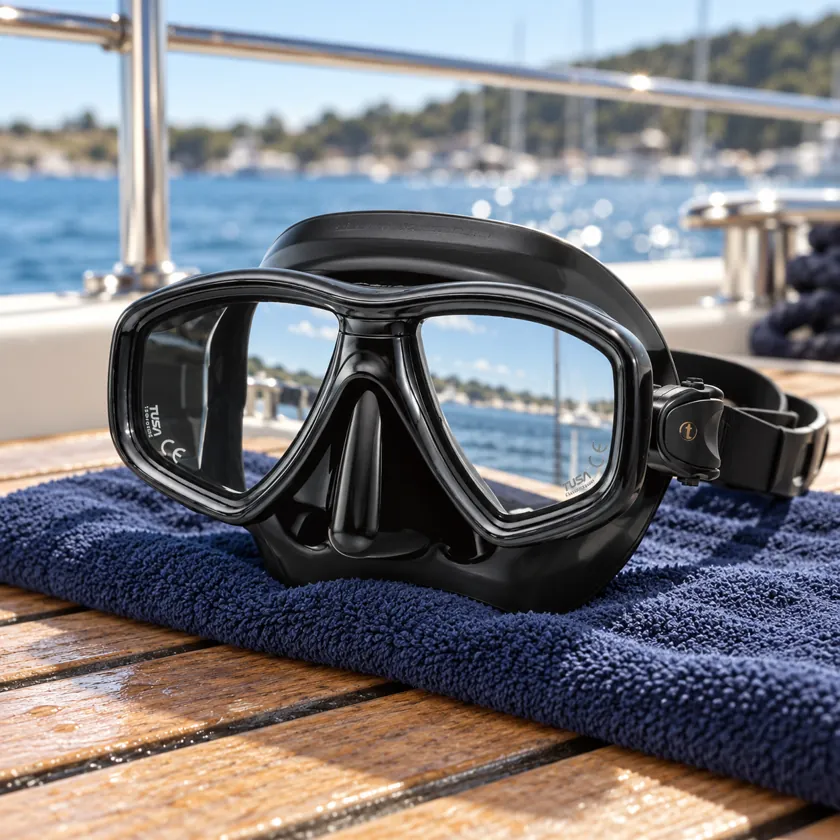 TUSA Freedom Ceos M-212 | Compact Dual-Lens Fitting Candidate | Twin lenses | Verify the exact supported optical-lens parts. | Check price on Amazon |
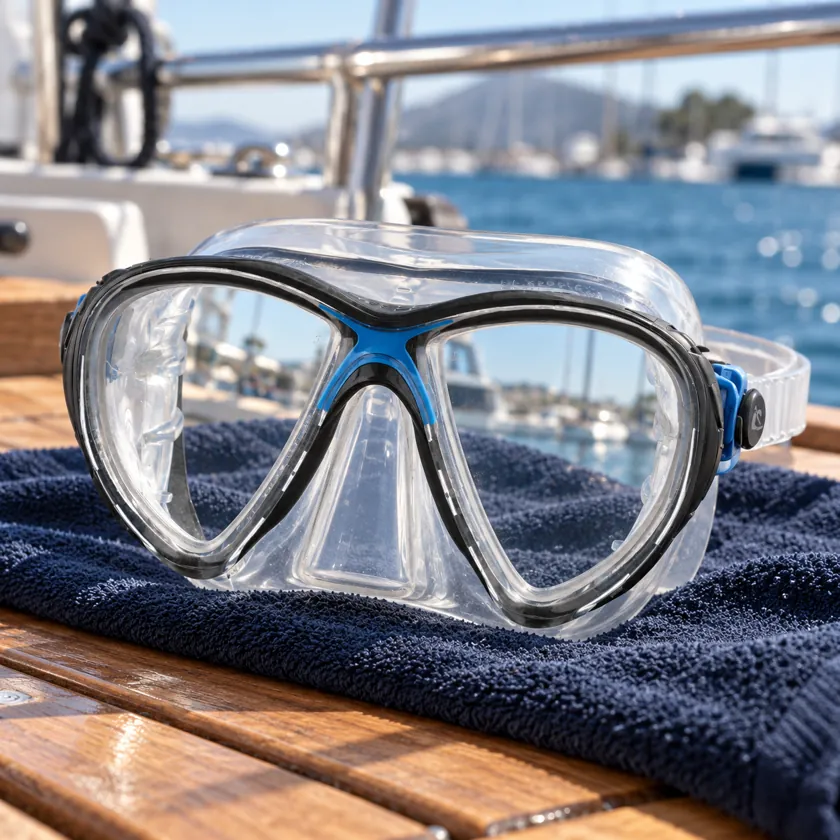 Cressi Big Eyes Evolution | Downward-View Design to Compare | Twin, angled lenses | Match optical accessories to the precise model. | Check price on Amazon |
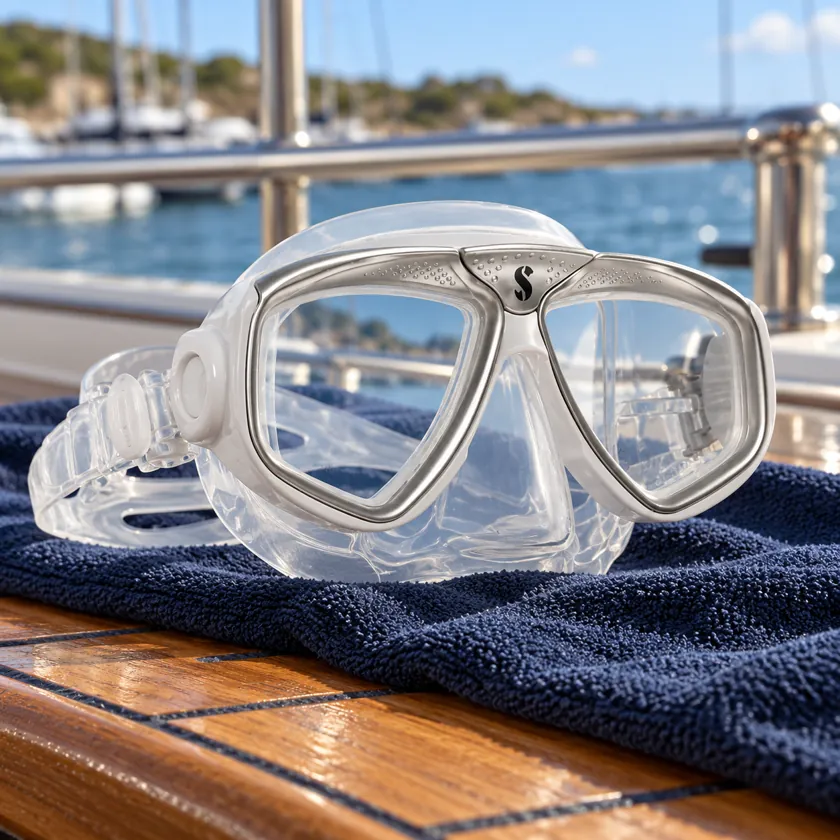 SCUBAPRO Zoom | Lens-Change System to Investigate | Twin lenses | Confirm optional lens parts and the lens-change instructions. | Check price on Amazon |
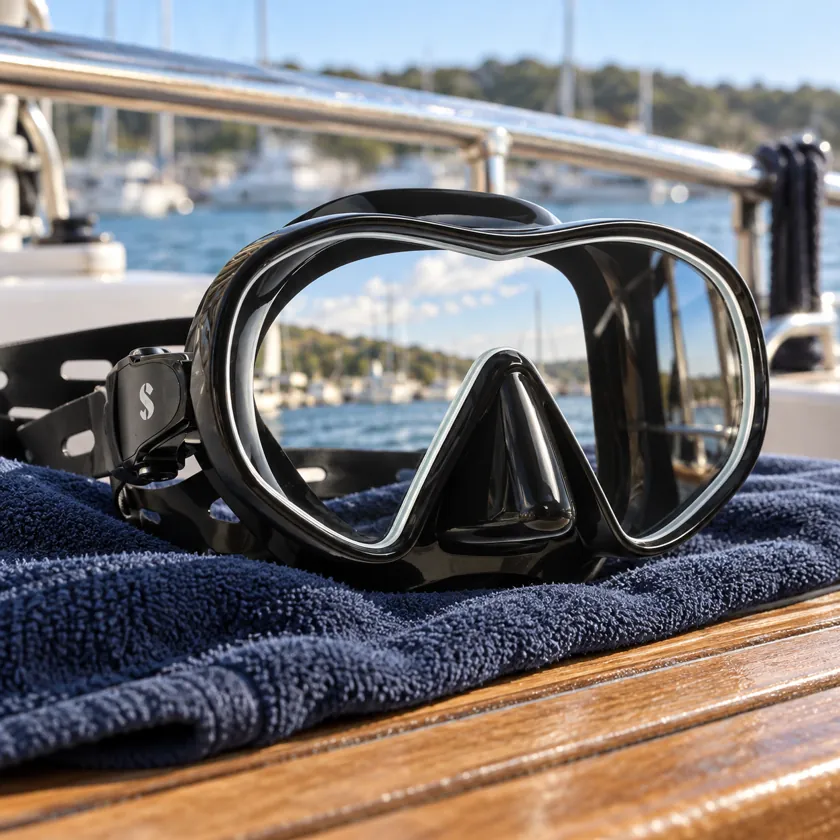 SCUBAPRO Solo | Alternative Framed Single-Window Fit | Framed, single window | The official specification excludes interchangeable prescription lenses. | Check price on Amazon |
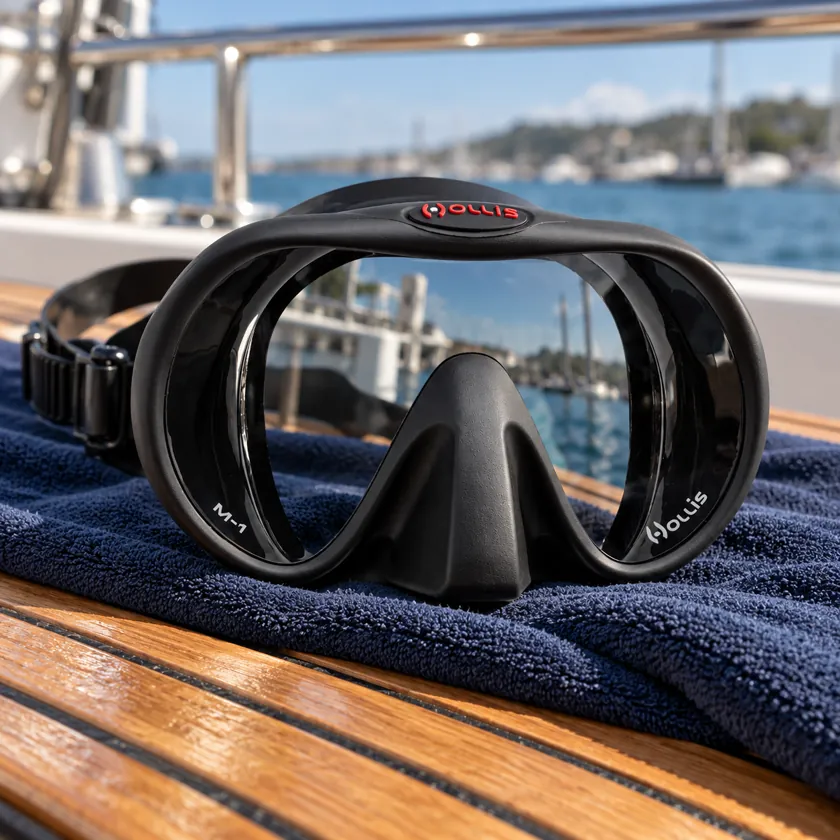 Hollis M1 | Frameless Single-Window Alternative | Frameless, single window | Confirm the low-iron-glass version, skirt and supplied package. | Check price on Amazon |
1. TUSA Freedom HD M1001 — Best Single-Window Fitting Starting Point
The Freedom HD is the first mask we would try for a single-window setup. Its rotating buckles and adjustable strap angle offer useful fitting options when the basic skirt geometry already suits the diver.
Key Features
- Framed single-lens design
- Freedom silicone-skirt technology
- 180-degree rotating buckle system
- Five-position strap-angle adjustment
- Published internal volume of 265 cc
Why It’s Our #1 Pick
The Freedom HD earns our first position as a fitting candidate because it combines a single viewing window with a rotating buckle system and several strap-angle positions. Those adjustments give a diver useful ways to place the strap without simply tightening it harder. For someone who wants a broad central window and does not need drop-in corrective lenses, that is a practical combination to examine.
It also gives you a clear comparison against the alternatives. Try the Solo for another framed single-window fit, or the Hollis M1 to see whether a frameless skirt feels better around your nose and cheeks. The right answer depends on the contact points and seal, rather than the number of adjustment features alone.
We would move the Ceos, Zoom or compatible Big Eyes Evolution higher on a personal shortlist when interchangeable optics are essential. Our top pick is therefore a starting point for the stated single-window use case, not a claim that one skirt will fit every face.
What to Consider
Compare it directly with the Solo if you want a framed single-window mask, and with the M1 if you want to examine what a frameless design changes. Use the same mouthpiece during each fitting.
Pros
- Several strap-position adjustments
- Uninterrupted central window
- Clear M1001 model identification
Cons
- Frame clearance needs a personal fitting
- Adjustment cannot correct every skirt mismatch
- Not the obvious choice for drop-in prescription lenses
Who Should Buy It?
Try the Freedom HD if you want a single window and adjustable strap routing. Choose from its actual seal and frame clearance with your normal mouthpiece.
2. TUSA Freedom Ceos M-212 — Best Compact Dual-Lens Fitting Candidate
The Freedom Ceos changes both the window layout and the optical options. It is the TUSA model to compare when you prefer two lenses or want a supported route to compatible corrective lenses.
Key Features
- Two-window mask
- Freedom skirt technology
- Three-dimensional mask strap
- Quick-adjust buckles
- Compatible model-specific optical lenses
- Published internal volume of 180 cc
Why It Makes the Shortlist
TUSA also documents compatible Freedom Ceos reading and corrective lenses. The reading-lens documentation identifies the M-212 explicitly and warns that some strengths are unavailable in certain markets. This matters more than a seller’s general statement that a mask is prescription ready. A mask may accept a lens family without a retailer stocking the strength or side you require. Ask a qualified supplier to confirm the appropriate correction and exact parts rather than choosing a value from an online eye chart.
What to Consider
The Ceos product page and compatible reading-lens documentation identify the mask and optical accessories separately. Confirm the M-212 model identifier, lens parts and skirt color when comparing packages. Ask which lenses are supplied in the mask and which must be ordered separately. A photograph of corrective lenses beside a mask does not establish that the selected package contains them.
Pros
- Supported optical accessories
- Distinct twin-lens fit within the TUSA range
- Defined strap and buckle arrangement
Cons
- Optical parts add cost and ordering checks
- Lens strengths vary by market
- Bridge shape still needs a fitting
Who Should Buy It?
Choose the Ceos when its twin-lens fit works and the required optical parts are available. Confirm the M-212 identifier and selected lens package before ordering.
3. Cressi Big Eyes Evolution — Best Downward-View Design to Compare
The Big Eyes Evolution is worth trying when the view toward chest-mounted equipment matters to you. Its angled lens geometry and optical options make it a useful comparison with the Ceos and Zoom.
Key Features
- Twin angled lenses
- Inverted teardrop lens shape
- Differentiated silicone skirt
- Adjustable swivel buckles
- Model-specific optical-lens compatibility
Why It Makes the Shortlist
The model name needs particular care. Big Eyes, Big Eyes Evolution Classic, Evolution Crystal and mirrored-lens packages can appear close together in catalogs. They should not be collapsed into one set of tint, material and package claims. This entry concerns the ordinary Big Eyes Evolution design, with the manufacturer page identifying the Classic family. Check the exact part and skirt combination, especially if purchasing an older retailer listing whose name is abbreviated.
What to Consider
Try looking toward a watch-sized object below your normal forward line of sight during a dry fitting. The exercise compares what you can see in that fitting position; it is not an underwater field-of-view test. If the mask must be pressed painfully close to the face to create the view you want, choose another fit.
Pros
- Lens shape emphasizes downward viewing
- Supported optical options
- Flexible buckle positioning
Cons
- Classic, Crystal and mirrored versions differ
- Corrective lenses must match the model
- Bridge and skirt fit remain individual
Who Should Buy It?
Try it when you want to compare the downward view or need compatible optics. Match the exact Big Eyes Evolution version rather than shopping by the shortened family name.
4. SCUBAPRO Zoom — Best Lens-Change System to Investigate
The Zoom is the SCUBAPRO option to examine when an established lens-change system is a central requirement. Its dual-lens design supports compatible optical lenses, with a clear distinction between the standard mask and optional accessories.
Key Features
- Dual-lens mask
- User lens-change system
- Supported optional optical lenses
- Integrated buckles
- Compatibility with optional Comfort Straps
Why It Makes the Shortlist
The Zoom is worth fitting alongside the Ceos when access to replacement optics is important. Ask the supplier to identify which components are in stock locally and what happens if one lens is damaged before travel. A system that is simple to service on paper is less useful if the required lens must be imported with an uncertain lead time. Keep the original standard lenses if the manufacturer’s instructions and your storage arrangement allow it, clearly labeled for the model.
What to Consider
During fitting, assess the skirt with the strap only lightly adjusted and check nose access with the gloves you plan to use. Buying an easily changed lens does not solve an inaccessible nose pocket.
Pros
- Clear route to compatible optical lenses
- Defined lens-replacement method
- Optional strap choices
Cons
- Standard package may exclude corrective lenses
- The bridge can be unsuitable for some faces
- Local lens supply affects ownership convenience
Who Should Buy It?
Choose the Zoom when its fit works and its supported optical system solves your vision requirement. Include the lenses and fitting assistance in the total purchase decision.
5. SCUBAPRO Solo — Best Alternative Framed Single-Window Fit
The Solo is the alternative to put beside the Freedom HD if you want a framed single window. Its flexible buckle mounts provide another strap arrangement, with a clear limit on interchangeable prescription-lens support.
Key Features
- Framed single-lens construction
- Double-seal silicone skirt
- Flexible buckle mounts
- Single central viewing window
Why It Makes the Shortlist
The Solo belongs on the fitting list for a diver who wants one central window and does not require the Zoom’s interchangeable optical system. Compare the view through the center and down toward equipment, then check how the frame clears the nose and brow. Flexible buckle mounts may help the strap follow the head, but the skirt should remain comfortable without aggressive tightening. The retailer description reviewed during research used the word frameless; the manufacturer’s framed classification is the one used here.
What to Consider
This is a particularly useful example of why manufacturer verification matters. A retailer’s convenient feature label should not override the brand’s construction table.
Pros
- Another single-window fit to compare
- Flexible strap attachment
- Clear construction and optical limitations
Cons
- No supported interchangeable prescription system
- Frame clearance needs checking
- Do not confuse it with SCUBAPRO’s Frameless model
Who Should Buy It?
Try the Solo when you prefer a framed single window and do not need drop-in corrective lenses. Confirm that its nose and brow clearance suit your face.
6. Hollis M1 — Best Frameless Single-Window Alternative
The M1 is the frameless option to compare against the framed Freedom HD and Solo. Its silicone skirt and low-iron glass lens offer a different construction, especially for a diver who prefers one central window.
Key Features
- Frameless design
- Silicone skirt
- Single-window lens
- Ultra-clear low-iron glass
Why It Makes the Shortlist
The M1 is the clearest contrast to the Solo for a buyer who wants to compare framed and frameless single-window masks in person. Look at the space around the nose, the way the skirt contacts the cheek and the view near the edge of the lens. The absence of a separate outer frame can change the way a mask packs, but it does not make the glass immune to impact or eliminate the need for a protective case.
What to Consider
Use the Hollis M1 manufacturer details to identify the lens and skirt configuration. A mixed-product retailer description can contain bullets about unrelated snorkels or accessories; those do not become mask features. Match the named mask, selected skirt and included case or strap with the actual package. Warranty eligibility is a separate seller and regional question, even when the product photograph appears correct.
Pros
- Frameless alternative to the other single-window masks
- Specified lens material
- No central lens bridge
Cons
- No equivalent drop-in optical system to the dual-lens candidates
- Glass still needs transport protection
- Skirt and selected version require a fitting
Who Should Buy It?
Try the M1 if a frameless single-window design is your preference. Choose it for its fit and lens configuration, rather than assuming low-iron glass overcomes poor water visibility.
How to Choose a Scuba Mask
Make fit the first decision, then narrow the lens configuration and accessories. Use the same mouthpiece, hood and vision correction during comparisons where possible. A mask that works well with that complete arrangement is more useful than a specification that looks impressive on a product page.
Which mask belongs on your fitting shortlist?
If interchangeable optical lenses are essential, begin with the Freedom Ceos, Big Eyes Evolution and Zoom. Establish the exact supported lens parts before judging colors or frame appearance; the mask and optical accessories form one purchase decision. The Zoom is particularly useful to compare when its listed lens-change system matters to you. Ceos offers a different frame and buckle layout, while Big Eyes Evolution gives a downward-view lens shape to assess against a chest-level instrument. None can be selected from prescription compatibility alone if the skirt does not fit.
For a single central window without that drop-in optical requirement, compare Freedom HD, Solo and M1. Freedom HD gives specific buckle-angle adjustments; Solo is a framed alternative; M1 is the frameless, low-iron-glass option. Try those structural differences with the same mouthpiece and exposure gear. A mask that seals only with excessive strap tension should leave the shortlist regardless of its lens material. Choose a backup independently enough to confirm its own seal, then protect both masks from being crushed in the same unpadded compartment.
Three practical fitting scenarios
For a first mask, begin with access to a fitting and a clear return policy. An entry-level buyer often has less experience distinguishing a pressure point from a normal feeling of a new skirt. Bring the mouthpiece or ask the shop to use an appropriate fitting arrangement. Compare two or three genuinely different shapes, record where each contacts the face, and avoid turning the appointment into a search for the strongest suction. A mask that briefly adheres during a dry demonstration has passed only one limited check.
For a diver changing to a hood, repeat the fitting with the hood positioned as it will be worn. The edge should not casually be folded beneath the sealing surface. Ask an instructor or equipment professional to help establish the arrangement if you are unfamiliar with it. A previously comfortable mask can behave differently when a hood, hair or a different strap route changes the seal. Buying another mask without examining those changes can leave the original cause unresolved.
For a diver who needs reading help, identify the task before buying optical accessories. Reading a wrist computer, seeing distant objects and correcting different prescriptions are different requirements. Discuss the correction with an appropriate professional and a supplier who understands the chosen mask system. Check left and right lens references rather than assuming every insert is interchangeable. Test visibility of your own instrument while following normal fitting advice, leaving time for adjustments before the trip.
Confirm the mask, lenses and package
Treat a standard clear-lens mask, optional optical lenses and an assembled optical package as separate purchases unless the supplier explicitly combines them. Ask for the exact model and lens identifiers, including left and right parts where relevant. Confirm who performs any required lens fitting and what the applicable instructions allow. A product family name cannot establish that an accessory fits the frame selected.
Check the policy for a fitting that reveals pressure points before taking the mask into the water. Dry fitting, seal inspection and mouthpiece checks are useful screening steps, but they are not a guarantee of an underwater seal. Avoid adding coatings, abrasive treatments or replacement parts until the exact manufacturer instructions and the supplier’s return conditions are understood. If a frame needs modification to become tolerable, a different fitting candidate is usually a more useful comparison than an improvised alteration.
A comparison framework that puts fit first
A scuba mask does not fit because of a headline rating. The skirt must follow the diver’s own facial contours around the forehead, cheekbones, bridge of nose and upper lip. Even small differences in the skirt shape can change whether the mask feels secure. The shortlist includes several constructions to accommodate different face shapes and lens needs. Try the M1’s frameless body, the Ceos’s dual-window frame or Cressi’s teardrop lens arrangement and compare how each sits on your face. An in-shop test can reveal obvious pressure and gaps. It cannot fully replicate the effects of a regulator mouthpiece, facial movement, hood or immersion.
Try each candidate without overtightening the strap, then repeat the fit check with your usual mouthpiece and hood. Evaluate whether the nose pocket can be reached for equalization and whether the lenses provide a useful downward view. A mask that sticks briefly under light suction is not guaranteed to stay leak-free underwater. Facial hair can affect the seal, so assess the actual fit instead of relying on a beard-friendly label. If a mask pinches or requires extreme strap tension, eliminate it even when it appears first in a retailer ranking.
Frameless versus framed masks: real trade-offs
A frameless design such as the Hollis M1 attaches the skirt to the lens without a conventional surrounding frame. That can reduce bulk and make some models easy to pack as a spare. It may also place the lens closer to the eyes. But the absence of a rigid frame does not ensure superior visibility or fit, and a damaged frameless assembly may have different repair options from a framed mask. Lens shape, skirt geometry and the nose pocket remain important. Buyers should verify how the strap connects and whether replacement straps and buckles are available for the exact version.
Framed masks, including Solo and Zoom, can accommodate mechanisms such as removable lenses or distinct buckle mounts. A frame may feel different across the brow or nose, particularly during extended dives. Its mere presence does not mean a mask is bulky or low-quality. Rather than proclaiming a design winner, compare which models have supported optical inserts, which have user-replaceable hardware and which fit the intended use. A buyer who values correction options may rationally prefer a framed mask that fits well over a compact frameless product.
Single lens versus dual lens for scuba
The number of lenses is not an accurate shortcut to practical field of view. Lens size, angle and distance from the eyes influence how much of the surroundings a diver can see. A large single lens may give an uninterrupted central appearance while a carefully designed dual lens offers useful downward vision. The Cressi Big Eyes models are examples of the latter approach; Cressi emphasizes the orientation of the glass rather than merely the number of panes. Consider whether the frame intrudes on the center of the field, especially when looking at an instrument or toward a buddy.
The choice also affects corrective-lens options. Some twin-lens masks accept model-specific replacements for each eye, which can be helpful when prescriptions differ. Not every prescription or optical need is supported by stock inserts, however. When comparing designs, treat the visual experience as something to try in person, ideally while wearing the correction required for safe diving. A high-quality lens is not useful if the mask leaks or produces pressure discomfort.
Prescription compatibility: verify the exact system
The difference between Zoom, Freedom Ceos, Big Eyes Evolution and Solo is especially important for readers who need corrective vision. Manufacturer materials identify optical-lens pathways for Zoom, Ceos and Big Eyes Evolution, while SCUBAPRO specifically describes Solo as lacking prescription-lens compatibility. These are not minor technicalities: buying the wrong mask may force the reader to replace the entire assembly or seek a more expensive custom solution. Distinguish “optical lenses available” from “optical lenses included.”
Corrective inserts may be sold separately, may only cover a limited prescription range and may require installation by a shop or optical specialist. A person with significant astigmatism, prism correction or other particular visual requirements should not assume a simple stock diopter replacement will address the need. Check left and right lens availability, the model number and whether the inserts remain obtainable in the local market. If the product has a lens-change mechanism, follow that manufacturer’s specific procedure. Do not modify a mask or lens assembly with improvised adhesive.
Comfort, skirt material and strap pressure
Manufacturers use different silicone formulations, shapes and skirt supports. Some products emphasize softness; others describe ribs or structures meant to stabilize the skirt. Those descriptions help explain engineering choices but do not prove a universal seal. Silicone that feels soft on the fingers can still press uncomfortably against particular parts of a face. TUSA’s Freedom skirt design, for instance, should be evaluated on comfort and seal rather than interpreted as a guarantee that every diver will be leak-free.
Strap tension is another frequently misunderstood factor. The strap holds the mask in position; it is not meant to force a poorly fitting skirt against the face. Too much tension can distort the material and create leaks. Test the buckle with the equipment normally worn, especially with gloves or a hood. Note whether the adjustment creeps or the strap catches hair. If small changes in tension alter the seal dramatically, compare a different skirt shape rather than assuming a special strap accessory will solve everything.
Internal volume and clearing
Low internal volume is a recurring manufacturer claim because less enclosed space can help some divers clear a mask. It does not mean that every low-volume design will be simpler for every person. The nose pocket must allow appropriate equalization and the mask must be stable while the diver follows trained clearing procedures. A tiny mask that compresses the nose or eyelashes can be much less practical than a somewhat larger design that fits comfortably. The published internal volumes for Freedom HD and Ceos can provide context, but figures may use different measurement methods and may not be presented consistently for every size or version.
A new diver should focus on fit and the ability to perform mask skills correctly within instruction. Choose a model whose seal can be managed calmly and predictably. If repeated leakage occurs because of facial shape, the appropriate response is to test alternatives, not to rely on an advertised volume number. Assess clearing and other mask skills under instruction; a low-volume claim cannot establish how easily you will manage a particular mask.
How a regulator mouthpiece changes mask fit
One of the most valuable practical tests is to put a regulator mouthpiece in place while trying a mask. Holding the mouthpiece can change the shape of the cheeks and upper lip, especially near the bottom of the skirt. A mask that looks well sealed with the mouth relaxed may have a new gap when the jaw assumes a diving position. The shape of individual mouthpieces differs, so the same mask may behave differently with different equipment. That is why a showroom suction demonstration alone is not decisive.
If the skirt lifts near the nose when the mouthpiece is held, try adjusting the mask position gently rather than immediately tightening the strap. Compare an alternative mask with a different nose or upper-lip shape. If you dive with a hood, repeat the check in your usual configuration. Persistent leakage is a reason for a new fit assessment before moving into demanding conditions. This buying guide can identify designs worth trying; it cannot diagnose or guarantee how a model will seal on an individual person.
Choosing a mask for travel and backup use
Compactness matters to some divers, particularly those carrying equipment on flights or storing a spare in a dive bag. A frameless mask may fold into a relatively compact case, but not all soft designs tolerate compression in the same way. Verify the manufacturer’s storage instructions and protect the lens against impact. Do not assume the smallest packed option is appropriate as a primary if it causes discomfort or limits useful vision. A backup should be familiar, usable and appropriate to the diving configuration for which it is carried.
Travelers who depend on optical lenses should think through replacement availability before the trip. If a prescription component is specialized, a spare mask or a practical recovery plan may be important. Check whether a replacement strap can be sourced at the destination and whether rental masks are suitable for individual vision needs. For every candidate, include size, weight and protective case details only when actually supported by the exact manufacturer’s specification. Do not invent packed dimensions or weights merely because the mask looks compact in a photograph.
Care, fogging and lens treatments
New and used masks need care appropriate to their lens material and construction. Rinse according to the manufacturer’s instructions after exposure to saltwater and inspect for grit under the skirt. Lens coatings, optical inserts and special glass may have cleaning restrictions. Avoid presenting toothpaste, flames or abrasive compounds as universal preparation methods. Some masks require manufacturer-specific treatment before first use; others can be damaged by methods circulating in online forums. A manufacturer-approved anti-fog product may help manage fogging, but the diver must still maintain a good fit and practice clearing skills.
After each dive, inspect straps, attachment points and lens edges for signs of damage. Allow the mask to dry in a suitable shaded environment and protect it from heavy objects during storage. If a buckle cracks or a skirt tears, check whether approved replacement components exist rather than attempting untested repairs. Readers seeking a step-by-step maintenance routine can use GearDeep’s separate mask cleaning and storage article.
What manufacturer specifications do not prove
A product listing may use terms such as panoramic, ultra-clear, low-volume or high-seal. These are useful clues to examine, but they do not by themselves establish comparative performance. Manufacturers may measure internal volume differently and may describe field of view using different reference masks. Statements such as “30 percent more visibility” require an explicit comparison context before they can be fairly used against another model. Check which reference model was used and whether the comparison applies to the version being sold.
Similarly, a brand’s claims about comfort cannot guarantee a diver’s facial seal. Look for the features that matter in your own setup. A model with tool-free optical-lens changes may be convenient for one reader and unnecessary for another. A mask with quick-adjust buckles may still be unsuitable if its skirt geometry does not fit. Use those practical differences to narrow your fitting shortlist.
Final selection checklist for your shortlist
Begin with the mask’s actual intended use and inspect the exact SKU. Confirm whether it is single- or dual-lens, whether its optical lenses are compatible and what is included in the box. Try the mask with the regulator mouthpiece, hood and other equipment normally worn. Check nose access, peripheral and downward vision, strap adjustment and the feel of the skirt across the forehead and upper lip. Reject a product that pinches or requires excessive strap tension. When online ordering is necessary, study the return policy before removing packaging or using the mask in water.
Before ordering, match the brand, model identifier, lens arrangement, skirt and included accessories against the official source. A generic mask photograph is not enough when an optical accessory or a particular skirt is essential. Resolve an ambiguous package with the supplier before payment. Record the confirmed model and supported lens parts so that a later replacement lens, strap or buckle is ordered for the same mask. Keep fit and package identity separate from a seller’s general claims about popularity or visibility.
Frequently Asked Questions
What Is the Best Scuba Mask for a Beginner?
The TUSA Freedom HD is our first fitting candidate for a beginner who wants a single window and does not need interchangeable corrective lenses. Try several masks rather than buying by the award alone. The skirt should sit comfortably with light strap tension, and you should be able to access the nose pocket and see the information you need.
Is a Single-Lens Mask Better Than a Dual-Lens Mask?
Neither layout is universally better. A single lens provides an uninterrupted central window, while certain dual-lens masks support model-specific corrective lenses. Frame shape and fit can differ substantially between models with the same lens count. Compare the useful view, nose access and optical requirements while wearing your normal equipment.
Which Masks in This Guide Support Corrective Lenses?
The Freedom Ceos, compatible Big Eyes Evolution versions and SCUBAPRO Zoom have manufacturer-supported optical options. Confirm the exact mask, lens family, side and available correction with a suitable supplier. A standard mask package does not automatically include the additional lenses, and similar names within a brand do not establish compatibility.
Should I Choose the Hollis M1 or SCUBAPRO Solo?
Try them together if you want a single-window mask. The M1 is frameless and uses low-iron glass; the Solo is a framed design with flexible buckle mounts. Choose from the way the skirt and frame sit on your face. Neither is the straightforward drop-in prescription alternative to the optical models in this comparison.
Does a Smaller Internal Volume Guarantee Easier Clearing?
Internal volume describes one design characteristic, but it does not establish the best fit or clearing experience for every diver. Skirt shape, mask position and technique also matter. Compare volumes only with care because manufacturers may not use the same measurement method, and learn the clearing procedure appropriate to your training.
How Tight Should the Mask Strap Be?
Use the adjustment needed to retain the mask comfortably, rather than tightening it to force an unsuitable skirt to seal. Excessive pressure can create discomfort and distort the contact around the face. Check the fit with your mouthpiece and hood, and seek fitting help if repeated leakage or pressure points remain.
Our recommendation
Final Verdict
Start with the TUSA Freedom HD if you want a single window and adjustable strap positioning. For a frameless alternative, try the Hollis M1; for a different framed single-window fit, compare the SCUBAPRO Solo.
,If supported corrective lenses are the deciding factor, compare the Freedom Ceos, SCUBAPRO Zoom and exact Big Eyes Evolution version around the lens parts you can obtain. The final purchase should follow the best seal, accessible nose pocket and suitable vision with your actual equipment.
Specifications and Manuals
For model details, see TUSA Freedom HD M1001 specifications, TUSA Freedom Ceos M-212 specifications, Cressi Big Eyes Evolution specifications, SCUBAPRO Zoom specifications, SCUBAPRO Solo specifications, Hollis M1 specifications.
About the author
Robert
Robert bohat acha bacha hay