
By Robert · Updated
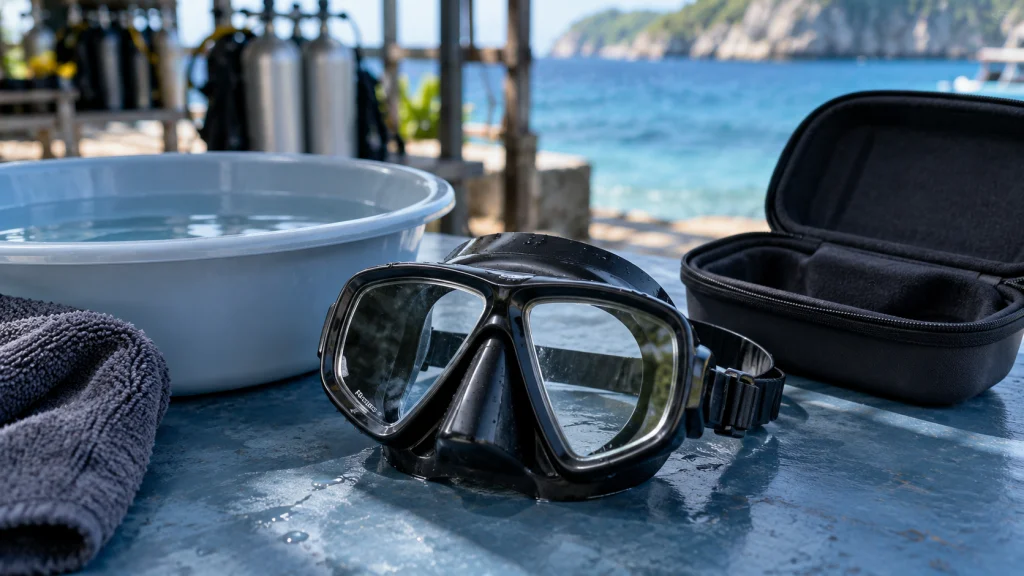
How to clean a scuba diving mask involves rinsing away salt and sand, drying it thoroughly, inspecting its skirt and strap, and storing it where it will not be crushed. Correct care protects the equipment you already own and helps identify problems before a dive. The guidance below draws on PADI and Divers Alert Network, while deferring to the manufacturer’s instructions for your exact mask model.
Why mask maintenance deserves its own routine
A mask is an essential piece of personal scuba equipment because it enables comfortable underwater vision. Its flexible skirt, strap, buckles and lenses all need attention. Routine cleaning prevents salt and sand from remaining in areas that contact the face or move during adjustment. Maintenance also gives you an opportunity to notice a tear or cracking before a dive. Divers Alert Network recommends examining mask straps for pliability, cracks and damage, and checking purge valves where fitted. The goal is not to perform complicated repairs. It is to recognize normal wear, follow the manufacturer’s care instructions and avoid taking equipment underwater when its condition is uncertain.
Rinse the mask after diving
Rinse the complete mask with clean fresh water after each use, according to the manufacturer’s instructions. Pay attention to the skirt folds, the nose pocket, the strap and the points where hardware attaches to the frame. Salt crystals or grit may hide in those areas and later cause discomfort or interfere with adjustment. If the mask has movable buckles, gently operate them during rinsing when the design permits it. Do not force a jammed part. Divers Alert Network recommends rinsing, letting the mask dry fully and moving compatible parts to help release salt and sand. A freshwater rinse is basic gear care, but it is not necessarily equivalent to sanitizing equipment that has been shared among multiple users.
Dry the mask without warping it
After rinsing, allow water to drain from the nose pocket and frame. Air-dry the mask in a protected, ventilated location rather than leaving it under intense direct sunlight or near a heater. PADI recommends keeping masks out of direct sunlight as much as possible and storing them in a cool, dry location. Avoid weighting the mask down or leaving it trapped beneath heavy dive gear while the skirt is soft or damp. Check inside the skirt before closing the storage case; pooled water can remain where the material folds. You do not need to use heat to speed drying. Gentle handling protects the frame, strap attachments and flexible sealing edges.
Inspect the skirt for seal problems
The skirt is the flexible surface that touches the face. Examine it around the forehead, cheeks, upper lip and nose pocket. Look for cuts, tears, unusual stiffness, warped edges or areas that have pulled away from their original position. A skirt can appear clean while still providing an unreliable seal if damaged. When assessing fit, place the mask on your face gently and check that its edge lies evenly against your skin. Hair or a shifted hood can create apparent leaks even when the material is intact. If a mask repeatedly leaks, do not simply tighten the strap excessively. Compare the fit to your original experience and consider whether a professional should inspect the equipment or a different mask would suit you better.
Check straps, buckles and adjustment points
Before each dive trip, examine the entire strap, especially near the buckle and any sections that bend repeatedly. Watch for cracking, torn edges, stretched or brittle material, and damaged attachment points. Test whether the adjustment mechanism holds its setting and releases normally. DAN lists strap condition among important mask inspection points, while PADI recommends carrying an appropriate spare mask strap in a save-a-dive kit. Replacement straps must match the model and attachment system; a similar-looking part is not automatically compatible. If the buckle is cracked or will not hold securely, do not rely on a temporary improvised repair for a dive.
What to do with a fogging mask
Fogging reduces usable vision and is frustrating, but a fog-free mask is not achieved simply by overtightening it. Before a dive, use an appropriate defog product according to its instructions and the mask manufacturer’s lens-care guidance. PADI recommends applying a defog solution before diving. Some new lenses may have manufacturing residue that needs a specific preparation process, but lens materials and coatings differ. Do not automatically follow abrasive cleaning advice found online: rubbing compounds, flames, toothpaste or chemicals can damage certain coated or plastic lenses. If you are uncertain whether a treatment is safe, ask the manufacturer or a knowledgeable dive shop. Follow your training if vision becomes impaired during a dive.
New masks and factory coatings
New masks may require preparation before their first use, but there is no universally safe method for every lens. Manufacturers may specify different treatments based on glass, coatings, adhesive or frame construction. Read the exact model’s instructions first. PADI notes that some new mask lenses need to be cleaned of manufacturing residue, and recommends following advice from the dive center and manufacturer. Avoid using an open flame or aggressive polish without explicit approval for the exact product. If a recently purchased mask keeps fogging despite correct care, seek guidance from its manufacturer or retailer rather than experimenting with increasingly harsh methods. Preserving the integrity of lenses and seals matters more than a popular shortcut.
Prescription lenses need extra care
Masks fitted with prescription inserts or custom lenses deserve careful treatment. Check whether the corrective lenses are removable, how they are secured and whether special coatings are present. Cleaning methods that might be acceptable for plain tempered glass can damage some coated surfaces or adhesive assemblies. Follow the optical supplier’s and mask manufacturer’s instructions, not a generic internet guide. Inspect for any looseness or damage before diving. If a prescription lens needs replacement, confirm compatibility with the exact mask model. Avoid assuming lenses from one model will fit another simply because both masks have a similar external shape. Good care is especially important when you rely on the mask to read instruments clearly underwater.
Shared and rental masks require additional attention
A mask that is shared or rented may need cleaning and disinfection, not only a freshwater rinse. DAN’s infection-control guidance distinguishes removal of salt and dirt from reducing potential microorganisms. Use a process and disinfectant suitable for the mask’s materials and approved under the operator’s procedures and relevant manufacturer guidance. Do not apply random household disinfectants to silicone, straps, lens coatings or adhesive components. Follow the specified dilution, contact time and final rinse instructions if a permitted product requires them. If you are using rental equipment, ask the operator how it is cleaned and inspect the skirt and strap before accepting it. Proper disinfection practices protect users without unnecessarily damaging equipment.
How to store a mask between trips
Store your clean and completely dry mask in its protective case or a suitable compartment that keeps heavy objects from pressing on the skirt and lenses. DAN advises protecting masks from compression and preventing deformation during travel and storage. Keep the case in a cool, dry area away from direct sunlight. Avoid placing weights, cylinders or densely packed gear on top of the mask. Do not allow loose hardware to scratch lenses inside a bag. Some light-colored silicone can discolor after contact with other materials; PADI specifically warns about clear silicone touching neoprene. Discoloration is not automatically proof of failure, but the mask still needs an inspection for actual physical deterioration.
Packing a mask for travel
A mask may be small compared with fins or a BCD, yet it is vulnerable when squeezed into an overloaded bag. A protective box helps prevent the lenses from receiving impacts and keeps the skirt from remaining folded in an awkward position. Place the mask where it will not be crushed by heavy accessories. If you travel with prescription lenses, consider how you would manage a damaged or lost mask at the destination. Carrying appropriate spares may be useful, but confirm your travel arrangements and gear requirements. Inspect the mask after a flight or long drive rather than assuming the case has prevented every possible problem. Gear that looks fine in the hotel room should still receive a pre-dive functional check.
Pre-dive inspection checklist
Before leaving for the dive site, examine the lenses for cracks or damage, inspect the skirt for tears and check the strap and buckles. Ensure the nose pocket is intact and accessible for equalization. If the mask has a purge valve, verify its visible condition as recommended in DAN’s equipment guidance. Try on the mask with the mouthpiece and hood you intend to use, where practical, to ensure the fit remains comfortable. Apply compatible anti-fog treatment at the appropriate point before diving. Keep the mask protected from being stepped on while setting up equipment. If something seems different from a normal fit, investigate rather than treating a flooded mask as an unavoidable inconvenience.
When to replace parts or retire the mask
Replace a worn strap or compatible buckle component according to the manufacturer’s instructions. A clearly damaged sealing skirt or cracked structural component may make replacing the mask more appropriate than attempting a home repair. Do not use household adhesives or improvised attachments for components that must retain the mask securely. A professional dive shop or manufacturer can advise whether genuine parts are available for the exact model. A mask can also become unsuitable without visible damage if changes in fit cause repeated leaks or painful pressure. Rather than relying on aggressive tightening, reassess the fit. The central question is whether the equipment functions reliably and comfortably for the intended dive.
Common mistakes to avoid
Do not store a mask wet in a sealed bag for an extended period. Do not leave it exposed in the back window of a hot car or under direct sunlight at a dive site. Avoid harsh chemicals and unapproved abrasive cleaning methods. Do not ignore a strap that has started cracking just because it held during the previous dive. Do not stack heavy weights or cylinders over the mask case. Avoid treating freshwater rinsing as a universal disinfection method for shared gear. And do not assume a mask that fits another diver will fit you. These are simple distinctions, but they address the common ways mask condition and comfort deteriorate between trips.
Frequently asked questions
How often should a scuba mask be rinsed? PADI and DAN recommend rinsing it with fresh water after use. Should it dry in direct sun? A shaded, ventilated location is preferable. What if the lens fogs repeatedly? Check the manufacturer’s cleaning instructions and use compatible anti-fog treatment; avoid unapproved abrasives. Can you keep a mask loose in a dive bag? A protective case is safer against compression and impact. Is a damaged mask strap worth replacing? A genuine compatible replacement may be appropriate, but confirm the condition of the attachment hardware too. Does routine care replace training? No. Mask clearing, equalization and problem management are skills learned through qualified instruction.
Build a simple maintenance habit
A reliable routine has three phases. After a dive, rinse the equipment and allow it to dry. Before storage, inspect the skirt, lenses and adjustment hardware, then protect the mask against crushing and direct sunlight. Before the next trip, check fit and operating condition once more. The process should be adapted to the product’s manual and the dive conditions rather than treated as a universal maintenance specification. If you are considering a new mask because your current one leaks, first review basic fit issues and the condition of the skirt. For additional guidance on equipment selection, read GearDeep’s separate article on choosing a scuba diving mask that fits. Maintenance can preserve a good mask, but it cannot make an unsuitable facial shape suddenly fit. When a damaged or poorly fitting mask needs replacing, our scuba mask comparison separates lens systems, skirt designs and optical options.
References and related guides
Primary sources: PADI mask selection and maintenance; DAN equipment inspection; DAN cleaning and sanitizing guidance; DAN infection control. Read how to choose a scuba diving mask for fit guidance or browse the dive masks category. GearDeep provides general equipment information, not scuba instruction.
About the author
Robert
Robert writes about scuba-diving equipment for GearDeep, focusing on fit, compatibility and the practical differences between products. His buying guides use manufacturer specifications and manuals to help readers compare their options, understand important limitations and make informed equipment choices.