
By Robert · Updated
How to choose a scuba diving mask is primarily a question of facial fit, seal comfort and practical underwater use. An expensive mask that pinches or floods is a poor purchase, while a modestly priced model that fits securely may serve you well. This guide explains how to evaluate the parts of a mask, what to test before buying and which features matter for different diving conditions.
Start with the diving you actually do
A mask intended for a warm-water holiday does not need to be identical to one chosen for repetitive training dives, cold-water diving or underwater photography. Start by writing down your priorities. Are you wearing a hood? Will you use corrective lenses? Do you have difficulty reaching your nose pocket? Are you moving frequently between bright shallow water and darker sites? These questions change what constitutes a good mask for you. A convenient mask for travel may not have the exact skirt shape that seals comfortably on your face. Similarly, a mask advertised for a broad field of view may still obstruct an individual diver’s downward sight line. Fit comes before marketing claims. If you can, compare several masks in person at a reputable dive shop and ask whether the exact model can be tried under controlled conditions. Record the model and size rather than relying on the appearance of the frame; close-looking masks can have very different seals.
Understand the anatomy of a dive mask
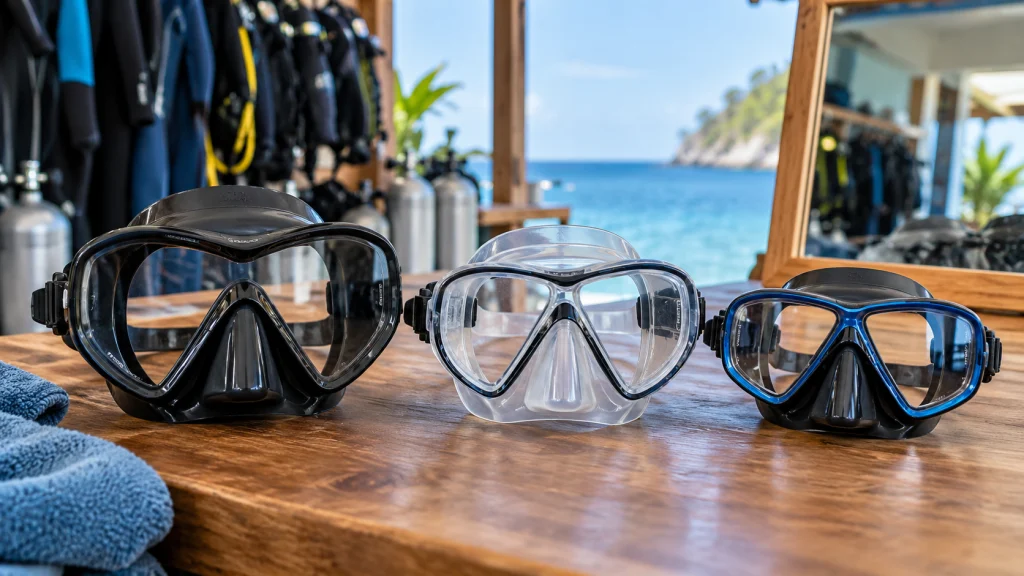
Most scuba masks combine a tempered-glass lens or lenses, a frame or frameless structure, a flexible skirt, a nose pocket, a strap and adjustment hardware. The skirt is the flexible material that meets your skin. The inner sealing lip helps exclude water when the mask is correctly positioned and equalized. The frame holds the lenses and supports the skirt, although frameless styles integrate these parts differently. The nose pocket permits you to pinch your nose to equalize your ears and to exhale into the mask during descent. The strap is primarily there to keep the mask in place; it should not have to crush the skirt against your face. Hardware matters because a buckle that is difficult to operate in gloves or a strap that catches hair can make routine use inconvenient. Check every component rather than assuming the lens configuration tells you everything about quality.
Perform a practical dry fit check
Try masks on with clean, dry skin and move hair clear of the sealing area. Place the mask over your eyes and nose with the strap out of the way. Check that the skirt contacts your face consistently, especially alongside your nose, under your eyes and across your upper lip. Take a gentle breath through your nose while briefly supporting the mask. A light temporary seal can reveal obvious mismatch, but it is not a definitive fit test. If a retailer suggests strong suction, remember that substantial negative pressure is neither necessary nor a substitute for fit in water. Then fit the strap and place a regulator mouthpiece in your mouth if available. Your cheeks and upper lip may move with the mouthpiece, creating a new gap. Smile, relax your face and move your jaw gently. If the skirt shifts or pinches in ordinary facial positions, try another shape. Do not buy a mask solely because it seals on the first attempt.
Check nose access and pressure points
A mask that seems secure can become uncomfortable during an actual dive. Pinch your nose through the nose pocket while wearing the mask. You should be able to do this without digging a fingernail into the skirt or moving the entire mask. Consider how a thick hood or cold-water gloves might change access. Next, notice the contact points at the bridge of your nose, below your nose and across your forehead. Pressure often becomes more noticeable after extended wear. The strap should sit comfortably on the back of your head, with tension sufficient to stabilize the skirt but not so tight that it distorts the seal. If you need extreme tension to prevent leaks, reconsider the mask rather than forcing a bad match. Persistent discomfort, recurrent leaks or impaired equalization deserve attention before the mask is used in challenging conditions.
Choose a lens arrangement for visibility and vision needs
Single-lens masks provide an uninterrupted central viewing area, but that does not automatically mean a wider practical field of view. Dual-lens masks can offer convenient compatibility with replaceable corrective lenses, depending on the model. Multi-window designs add side panels, which some users appreciate for peripheral awareness but others find distracting because frame borders remain visible. Try looking down toward a pressure gauge, sideways toward a dive buddy and upward toward the water surface. Notice whether the frame blocks the views you actually use. Corrective lenses deserve special consideration. Simple stock corrective inserts may address some spherical prescriptions, while astigmatism, different corrections in each eye or unusual prescriptions may require a custom solution. Never assume a brand’s available lens range matches your eye prescription; verify the precise mask model, lens compatibility and the advice of a qualified eye-care professional.
Understand internal volume and clearing
Internal volume is the space inside a mask between your face and the lenses. A low-volume design can be easier for some divers to clear because there is less space to displace, but a number by itself does not ensure easier skills or better fit. Your ability to maintain a seal, control exhalation through your nose and follow the procedure taught during training matters more than a slogan. Before selecting an especially compact mask, check that it does not press your eyelashes against the lenses or squeeze the nose pocket. Learning to flood and clear a mask is a basic scuba skill practiced with a qualified instructor. A diver who cannot reliably manage a flooded mask should not rely on purchasing a different mask to replace appropriate training. Choose equipment that complements your learned skills rather than masking an unresolved skill or comfort issue.
Skirt material, facial hair and hair management
Many masks use silicone skirts, but silicone composition, thickness and edge geometry vary. The feel against your face is more informative than color alone. A soft skirt may accommodate some facial shapes comfortably, while another diver may prefer a more structured edge. Transparent skirts allow more light around the edges; dark skirts may reduce stray light and reflections for some users, particularly photographers. Neither style guarantees visibility or performance. Facial hair passing underneath the sealing line can create leak paths, especially where moustaches meet the upper lip. Results vary with hair and face shape. Try the actual mask and avoid promises that any specific style is fully beard-proof. Keep long hair clear of the sealing lip and strap. A comfortable strap cover can reduce hair pulling, but confirm that accessories do not interfere with secure adjustment.
How a hood changes the fit
A diving hood changes how the mask strap rests on your head and can sometimes interfere with the skirt near your temples or forehead. Test the mask with the hood you actually plan to use. The hood should not sit underneath the mask’s facial sealing area unless the equipment and training specifically call for that arrangement. A mask can seal comfortably in a shop without a hood and become unreliable when the hood pushes against its skirt. Gloved hands can also make small buckle controls and nose equalization harder. For cold-water environments, prioritize functional access over styling. The way a hood integrates with other life-support equipment depends on your configuration; have your instructor or qualified dive professional assess it before a demanding dive. It is worth performing these checks while calm and on land rather than discovering incompatibilities underwater.
Avoid common purchasing mistakes
One common mistake is buying solely from a photograph without assessing the skirt shape. Another is assuming a costly mask must fit better. Price can reflect materials, lens treatments, brand positioning and design, but cannot predict a particular face’s geometry. Do not confuse a large-looking lens with guaranteed peripheral visibility, or a low-volume claim with guaranteed easy clearing. Check for replacement straps, manufacturer instructions and lens compatibility if you will need repairs or corrective inserts. Confirm what the product package contains; a listing may show a case, anti-fog accessory or snorkel that is not included with every variant. Read the model number carefully, especially when comparing similar masks marketed in different sizes. If ordering online, investigate a retailer’s return policy before removing labels or using the mask in water. Keep the packaging until you are confident the fit is acceptable.
Maintenance, storage and inspection
Rinse the mask according to the manufacturer’s care instructions after diving, especially after saltwater exposure. Keep sand and grit away from the sealing lip because trapped particles can create leaks and accelerate damage. Inspect the strap for cracking, the buckle for operation and the skirt for tears or distortion. Avoid leaving equipment in direct sunlight, excessive heat or an unsuitable chemical environment for long periods. Store the mask in a protective case when practical so heavy objects cannot deform it. Do not use abrasive cleaning materials or solvents without explicit manufacturer approval. Lens surface treatments vary, and aggressive home methods can damage coatings. For fogging, follow the mask maker’s preparation and anti-fog recommendations rather than relying on universal internet advice. Recheck the seal after replacing a strap or inserting corrective lenses; changes to the assembly can affect how the mask sits on your face.
What to do about persistent leaks
Leaks do not always mean the mask is defective. Hair under the seal, a shifted hood, a twisted strap, an unsuitable skirt shape or pressure from a mouthpiece can all contribute. Begin with a calm fit and equipment check in a safe setting. If the mask requires excessive strap tension or repeatedly leaks along one part of the face, try a differently shaped skirt instead of compensating with tighter hardware. A mask that floods during use is an equipment-management matter covered in scuba training; follow your instructor’s procedures, and do not continue a dive when you cannot safely control the problem. Occasional minor leakage is different from repeatedly losing a seal. Note the exact conditions, such as hood use or facial expression, and discuss them with a knowledgeable dive professional. The solution may be a different mask rather than an accessory.
A shop-and-water evaluation checklist
Before buying, confirm these details: the skirt lies flat along your face; the nose pocket is accessible; the lenses provide useful viewing angles; the strap operates smoothly; no frame edge causes pain; the mask remains comfortable with a regulator mouthpiece; and any corrective lenses are genuinely compatible. If you dive with a hood or gloves, test them too. Examine the manufacturer’s instructions for lens and skirt care. If a trial in a pool or controlled open-water setting is available, use it to confirm the mask behaves as expected while moving your head, breathing through a regulator and completing mask skills already taught during training. This process takes more effort than choosing a popular online product, but it directly addresses the reasons a mask succeeds or fails for an individual. Keep a short record of which models fit and why. That information can be useful when replacing your mask later.
Final decision: fit first, features second
There is no universally best scuba mask. A model with excellent optics can still be unsuitable if its skirt leaks, its nose pocket prevents easy equalization or its frame causes persistent pressure. Choose first for facial fit, then consider lens arrangement, prescription requirements, clearing comfort, hood integration, strap hardware and price. For beginners, consult the instructor overseeing training, particularly if clearing or equalizing is uncomfortable. For experienced divers, changing to a new design warrants familiarization in a controlled environment before demanding dives. Our six-model scuba mask comparison applies these fitting priorities to identified designs. See our dive-mask category for related information, and use qualified instruction—not an online buying guide—as your source for underwater procedures.
Further reading and editorial notes
For related topics visit dive masks, scuba equipment explainers and our mask cleaning and storage guide. Useful external guidance includes Divers Alert Network guidance on mask squeeze. This is equipment education, not a substitute for training or individual medical advice. GearDeep does not claim to have field-tested particular masks in this article.
About the author
Robert
Robert writes about scuba-diving equipment for GearDeep, focusing on fit, compatibility and the practical differences between products. His buying guides use manufacturer specifications and manuals to help readers compare their options, understand important limitations and make informed equipment choices.