
By Robert · Updated
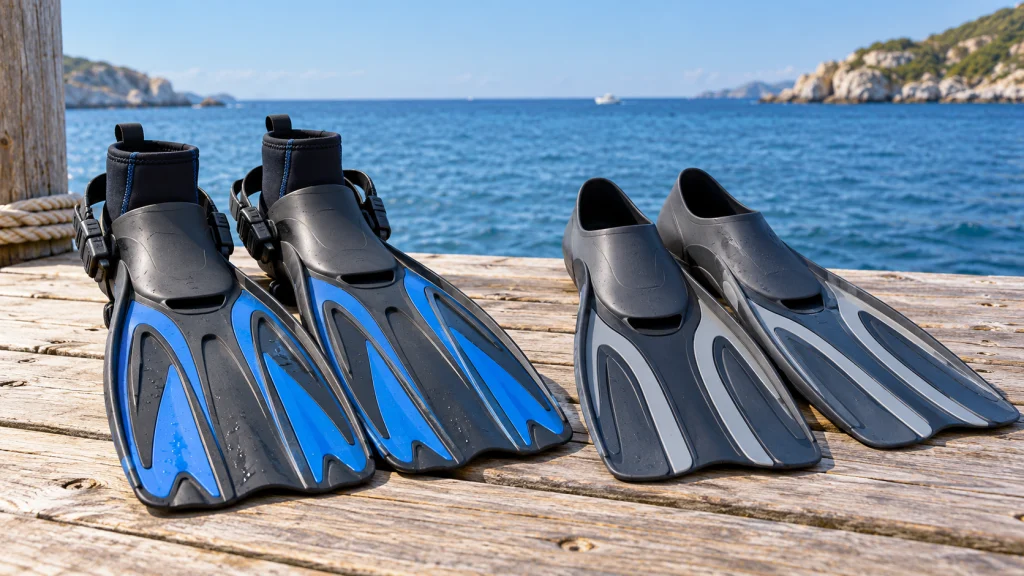
Open-heel vs full-foot dive fins is a practical decision about fit, footwear, shore access and diving conditions. An open-heel design typically works with a heel strap and often a dive boot, while a full-foot design encloses the heel. Neither is automatically superior; choose a fin that works with your training, conditions and feet.
What separates the two fin designs
Open-heel and full-foot refer to the shape of the foot pocket, not necessarily to the blade’s stiffness or efficiency. Open-heel designs leave the back of the foot accessible and use a strap to retain the fin. Full-foot designs enclose the heel in a continuous pocket. Both designs can come in several blade styles and sizes. That distinction matters because two open-heel models may feel more different from one another than an open-heel and a full-foot model. Avoid assuming that one heel style alone determines speed, power or energy use. Assess the complete fin, including the blade, fit and intended kicking technique. Manufacturers also use different names for their technologies; these descriptions are not directly comparable performance measurements.
When open-heel fins make sense
An open-heel fin is commonly paired with neoprene dive boots, especially for colder water or shore entries. The boot helps protect the sole when walking over rough surfaces and adds insulation, while the fin’s heel strap secures the foot. That combination is useful when you put on your fins after entering shallow water, rather than crossing difficult terrain while wearing them. Open-heel fins may also appeal to divers who want to adjust the strap around different boot thicknesses, although any adjustment range is finite. You should never assume a fin accommodates every boot. Test your exact boot and fin together. A boot that is too thick can crowd the pocket and leave the heel incorrectly positioned; one that is too thin can allow movement and rubbing.
When full-foot fins make sense
Full-foot fins are frequently considered for warm-water boat diving, where divers may have no need to wear substantial boots on shore. Their continuous heel pocket can feel simple and direct when it matches the foot properly. Some full-foot fins are designed for snorkeling rather than scuba, so check that the model is appropriate for the intended activity instead of selecting by appearance. A full-foot fin can be inconvenient if you must walk across sharp ground or use thick protective footwear. It can also become uncomfortable if the material rubs along the heel or toes. A thin fin sock may improve comfort for some divers, but changing what you wear inside a pocket changes its effective fit. Any sock must be compatible with the fin’s sizing guidance.
Boots, socks and the importance of sizing
Sizing numbers are only a starting point. A boot’s outsole thickness, toe shape and upper material all affect how it fits a fin pocket. Bring the boots you intend to use to the shop, and use our boot-and-fin fit checks when trying each fin in the correct size. With an open-heel model, the foot should seat fully into the pocket and the heel strap should remain secure without exerting painful pressure. With a full-foot model, you should not need to curl your toes to prevent it sliding. Avoid choosing a too-small fin based on the hope that material will stretch significantly. Check how easy it is to remove the fins without yanking on the strap or compromising balance. Manufacturers’ charts and shop advice are useful, but a comfortable real-world test is more persuasive than a generic shoe-size conversion.
Strap systems and buckle considerations
Traditional open-heel fins may use adjustable rubber straps with buckles, while other models offer spring or elastic-bungee straps. A spring or bungee system can simplify donning and removal, but it is not automatically more secure for every foot and boot pairing. Inspect how the strap attaches to the fin and whether spare parts are available. If you use thick gloves, test whether you can find and operate the release mechanism. A strap that twists or sits high above the heel can slip; a strap that is uncomfortably tight can aggravate pressure points. Learn the manufacturer’s recommended adjustment method and do not modify hardware casually. Carrying an appropriate spare strap where practical can avoid an interrupted dive trip, though divers should follow their operator’s equipment policies.
Blade shape, stiffness and kick style
Blade stiffness, length and construction can change how a fin responds to a flutter kick, frog kick or controlled maneuvering. A relatively stiff blade may feel responsive to one diver and tiring to another. A softer blade may be more comfortable for relaxed swimming but might not provide the sensation of control another diver prefers. Specialized designs can respond differently to changes in direction and kicking technique. Claims about reduced energy use or increased propulsion are difficult to generalize without comparable test methods and actual diver measurements. Instead, consider your usual environments and how your training teaches you to fin without disturbing a sensitive bottom. When possible, trial multiple models with the same boots and similar swimming conditions. Your own comfort and control are important criteria.
Travel weight and packability
Divers who fly often may care about the fin’s dimensions, weight and how it fits inside a luggage bag. Some full-foot models pack compactly, but there are also purpose-designed open-heel travel fins. Compare the published dimensions and actual weight for the chosen size; specifications may be listed per fin, per pair or without straps. Larger sizes naturally take more space. Do not buy an undersized fin merely to save luggage room. Think about whether the fins need protective padding, whether exposed buckles may catch on baggage, and whether wet boots will need separate storage after the return dive. If your trip involves borrowing cylinders and other heavy gear locally, fins that you already know fit reliably can still be worth the packing space.
Shore entries versus boat entries
Your entry method can influence footwear more than the fin blade itself. When shore access includes rocks, coarse sand or hot pavement, suitable dive boots can make the approach more comfortable, and open-heel fins commonly accommodate those boots. Walk to a safe entry point in suitable footwear and put the fins on according to your training and site procedures. On many boat dives, a full-foot setup is workable because divers put on their equipment near the entry point. Yet individual boat procedures vary, and no fin choice overrides the operator’s safety directions. Evaluate exits as well as entries: a ladder, choppy conditions or long surface swims may influence how easy it is to manage your fins and gear.
Cold water, warmth and exposure protection
In colder water, thermal protection for the feet may become a significant selection criterion. Open-heel fins worn with sufficiently protective dive boots are a common solution. Not every boot provides the same insulation, and water temperature tolerance varies between people. Consult your instructor or an appropriately qualified dive professional about exposure protection for the planned conditions. An overly tight fin pocket can compress the boot or restrict comfort even if the boot itself is rated for a cooler environment. Full-foot fins do not inherently provide the same options for thick footwear, but the suitability of any product must be judged individually. Your fin should work as part of an overall equipment system rather than being selected in isolation.
How to try fins responsibly
Start by assessing the dry fit and secure retention. Then, if a shop or instructor permits a controlled water trial, compare the fins using your ordinary kicking technique. Avoid judging a pair on one short burst of speed. Notice how they feel during a relaxed swim, controlled turns, hovering and a modest surface swim when conditions permit. Ask whether any discomfort arises from the blade response or from the foot pocket. If you notice rubbing, numbness or cramping, stop the trial and reassess fit and technique. A fin that seems powerful for a few kicks may become uncomfortable over an extended session. Always use trial conditions appropriate to your certification, ability and supervision; unfamiliar equipment should not first be tested on a demanding dive.
Care and inspection
Rinse fins as the maker directs after saltwater or sandy use. Look for damage near blade rails, foot-pocket edges, buckles and strap connection points. Sand trapped in moving hardware can interfere with adjustment. Allow the fins to dry appropriately before long-term storage, and avoid leaving them under heavy objects that bend the blades or deform the foot pockets. Do not assume all plastics and elastomers tolerate the same heat or cleaning products. Manufacturer guidance takes priority over generic cleaning tips. If a strap shows cracking or a buckle does not hold as designed, replace the affected component with compatible parts before the next dive. A small maintenance habit can prevent avoidable equipment problems and preserve the fit you chose originally.
Mistakes to avoid when shopping
Do not treat an expensive model as automatically more efficient. Do not order open-heel fins without checking boot compatibility, or full-foot fins without measuring and testing the fit. Avoid relying on broad statements such as ‘best for beginners’ without considering the diver’s kicking ability, entry conditions and comfort. A model that works well for a warm-water boat diver may be inconvenient on a rocky cold-water shore. Online listings can combine sizes and variants under one page, so confirm the exact configuration before purchasing. If you cannot try the fins before ordering, examine the return policy carefully. Do not remove packaging or use the equipment in water if doing so would invalidate the return before you have assessed the dry fit.
A decision checklist before buying
Write down your most common dive location, typical water temperature and entry method. Decide whether you require protective dive boots and record the exact model and size you own. With that information, choose whether you need a boot-compatible open-heel design or a full-foot design. Compare two or three appropriately sized candidates rather than shopping solely from rankings. Test comfort, heel retention and buckle operation, then inspect the blade material and overall dimensions. Assess packability if you travel by air. Ask a qualified instructor for guidance if you are unsure how the fin interacts with your finning technique or buoyancy control. Finally, verify the retailer’s exact product variant and manufacturer instructions. Taking these steps creates a more useful shortlist than picking a design from advertising alone. Use the footwear requirements to narrow the six designs in our scuba fins comparison.
Further reading
Continue with our fin care guide, scuba equipment guides, and the dive fins category. Equipment choice should follow the instructions of your qualified scuba instructor and the equipment manufacturer. This article explains general equipment differences and does not claim that any fin has been personally field-tested by GearDeep.
About the author
Robert
Robert writes about scuba-diving equipment for GearDeep, focusing on fit, compatibility and the practical differences between products. His buying guides use manufacturer specifications and manuals to help readers compare their options, understand important limitations and make informed equipment choices.