By GearDeep Editorial · Updated
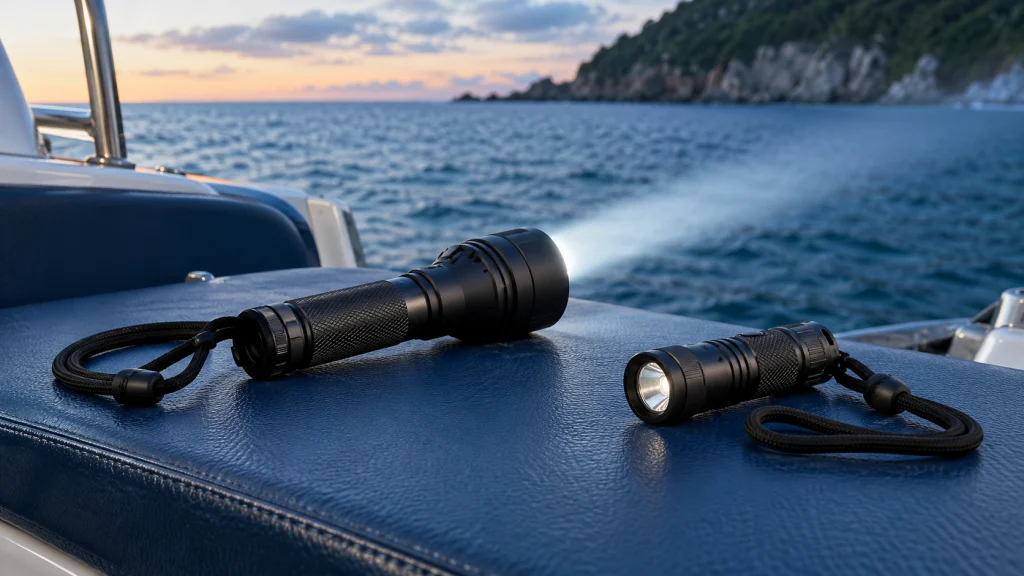
Primary vs backup dive lights is an important distinction when planning scuba illumination: a primary is used for the planned dive, while a backup provides independent light if the primary fails. This guide explains beam types, runtime, depth ratings, battery options and practical handling, drawing on guidance from PADI and Divers Alert Network. It does not replace the training needed for night or overhead diving.
The job of a primary dive light
A primary dive light is the lamp a diver expects to use throughout the planned portion of a dive requiring illumination. On a recreational night dive, that means revealing the route, helping the diver inspect surroundings and supporting light-based communications learned in training. PADI describes primary lights as typically providing a strong beam and sufficient coverage for the intended dive. This does not mean the physically largest or brightest product is automatically ideal. A powerful concentrated spot can be useful at distance while a broad, moderate beam can make nearby surroundings easier to examine. Your dive plan, training and local conditions determine which is suitable. Every light must be assessed as a complete system, including batteries, switches, seals, attachments and realistic runtime. A specification sheet cannot substitute for operating the lamp in controlled conditions.
What a backup light is expected to do
A backup dive light is independent illumination reserved for a primary-light failure. DAN recommends at least one backup on night dives and emphasizes planning around unexpected loss of visibility. A backup must be accessible with the equipment and exposure protection actually worn, and it must work when required rather than merely existing in a pocket. Compactness can help with stowage, but an inaccessible tiny button is not an advantage. Confirm that the lamp has adequate usable runtime for the intended contingency under the guidance of qualified instruction and the dive plan. A secondary lamp that shares a vulnerable power connection or storage arrangement with the primary may not provide meaningful redundancy. An emergency plan also requires buddy communication and an appropriate response to a failed light; simply switching lamps does not make the situation automatically safe.
Primary versus backup: key differences
The two categories are defined by their roles, not strictly by brightness. A primary is selected for sustained illumination during planned use and may have a larger housing, wider operating range or more ergonomic mounting options. A backup is chosen for independent reliability, accessibility and sufficient illumination during an unplanned failure. Some compact lamps can meet primary needs on one recreational dive and serve as backups in another configuration, but the diver still must plan actual redundancy rather than reclassifying the same device twice. Check whether the light is designed to remain secured while not in use, can be activated with gloves, and provides a visible indication of operating mode. Equipment requirements vary substantially between routine recreational night diving and overhead or technical diving. Never assume the same lamp configuration or emergency procedure applies to both.
Why headline lumens are not enough
Lumens describe the total amount of visible light emitted under particular conditions. A manufacturer may advertise maximum output, yet that does not describe how evenly the beam spreads, how quickly brightness decreases as battery charge falls or how the device performs through the planned dive. Compare the manufacturer’s published output with its runtime at that same setting. Be cautious when a marketplace listing provides only a headline maximum without identifying how long it lasts. Many multi-mode lamps can operate longer at lower brightness, so the maximum-output number is rarely the whole story. Apparent brightness also changes underwater with suspended particles and the direction of the beam. Look for clearly explained modes and practical controls, not merely the largest number in a search result.
Spot, flood and adjustable beams
A narrow spot beam concentrates light over a smaller area. It may help inspect a crevice or communicate across an appropriate distance in clear water. A broad flood illuminates more of the immediate surroundings, which may be helpful for general observation or close-range photography. DAN identifies beam width as an important choice and notes that adjustable lights can provide flexibility. Neither beam is categorically safer in all settings. Wide beams can increase backscatter in water with many suspended particles, while a tightly concentrated beam may be less comfortable for scanning a broad area. Divers should learn to manage where the beam points, avoiding direct illumination of buddies’ eyes and unnecessary disturbance of marine animals. An adjustable mode has value only if the control remains simple and reliable underwater.
Waterproof claims and depth ratings
A lamp sold as waterproof is not automatically suitable for scuba diving. The manufacturer should explicitly document the maximum operating depth and intended underwater application. A consumer flashlight designed for splashes or surface swimming may not withstand the pressure experienced on a scuba dive. Check that the stated depth exceeds the demands of your planned activity and that the device is used within manufacturer limitations. Understand whether a housing, end cap or charging port must be closed in a particular way before submersion. Do not improvise modifications to a seal or pressure housing. An impressive depth rating does not make a product suitable for every diving environment, and it says little about switch usability, beam quality or battery duration. For specialized overhead or technical dives, equipment configuration must follow the relevant training and protocols.
Runtime and realistic battery planning
A published runtime is meaningful only when the output setting and test conditions are clear. Some lamps maintain approximately constant output for a period before stepping down, while others gradually dim. Manufacturers differ in how they measure and report these behaviors. Plan using the mode you expect to operate rather than extrapolating from the most favorable low-output figure. Keep a margin for unforeseen delays as required by your dive training, the environment and dive operator. DAN specifically advises considering battery life and charging opportunities when selecting lights for night diving. If multiple dives are planned in a day, determine whether recharge time, spare compatible batteries and access to power will support the schedule. A partially charged primary lamp is not an acceptable substitute for a properly planned lighting configuration.
Rechargeable versus disposable batteries
Rechargeable lights can be economical for frequent use and avoid repeated single-use battery disposal, while designs using replaceable cells may be convenient when charging access is limited. PADI discusses both approaches and notes that frequent divers may find rechargeable systems worthwhile. Neither arrangement is automatically superior. Verify whether batteries can be replaced by the user, which exact cell chemistry and dimensions are approved, and how the light indicates remaining charge. Never substitute a battery that happens to fit physically if the manufacturer has not approved it. Improper charging, mixed cells and damaged batteries create risks beyond simple loss of light. Use the supplied or approved charger, and respect applicable travel rules for lithium batteries. Treat battery handling as a safety procedure, not merely a cost comparison.
Switches, locking and accidental activation
A light should be easy to operate intentionally but resistant to switching on by accident inside a gear bag or pocket. Test the control while wearing the gloves you use underwater. Small push-buttons can be difficult to identify by touch, especially if multiple modes must be cycled. A rotary head may have fewer settings but require deliberate adjustment and appropriate seal care. Lockout features can reduce accidental discharge, but they can also complicate quick backup activation if the diver is unfamiliar with them. Learn the mechanism before entering the water and confirm the state during the pre-dive inspection. The ideal arrangement allows reliable use without forcing the diver to focus excessively on the lamp. Do not modify an electrical switch or seal assembly to make it easier to operate.
Mounting and retention
Handheld, wrist-mounted and canister-style configurations place different demands on movement and stowage. PADI mentions handles and mounts as practical features, while DAN discusses canister systems in more specialized contexts. Choose a secure attachment that is compatible with the light and your training. A lanyard or clip should not create an uncontrolled entanglement hazard. Do not rely on a mount that blocks emergency access or requires both hands at an inconvenient moment. For a backup, the most important question is whether you can locate and activate it using your practiced procedures. If you intend to mount a light near hoses or buoyancy equipment, have an appropriate instructor or knowledgeable professional review the setup. A neat arrangement is valuable only when it remains secure and accessible.
Night diving is more than choosing a torch
A light is just one part of preparing for a night dive. DAN explains that orientation can be more difficult in darkness and describes backup lighting, communication and emergency signaling considerations. Training should cover buddy positioning, hand and light signals, navigation and responses to equipment problems. Prefer sites and conditions appropriate to your experience and the operator’s plan. An illuminated instrument display and suitable surface signaling equipment may also be relevant. The dive team should agree how lights will be used around one another, including how to avoid shining beams into faces. No buying guide can make an untrained diver qualified for night, wreck or cave conditions. Specialized overhead environments present additional hazards and require distinct instruction, equipment and planning.
Using a light around wildlife
Underwater lights reveal colors and details that ambient illumination may not show, but wildlife interactions should remain considerate. Do not continuously point an intense beam directly into the eyes of animals or crowd them for a photograph. Adjust light intensity and beam direction as appropriate while maintaining safe navigation and awareness. The goal of a recreational dive light is to aid observation without unnecessarily disrupting the environment. Avoid moving closer to fragile reef structures just to compensate for a narrow beam. Practice buoyancy and positioning so that managing the light does not cause contact with the bottom. If a dive operator or marine reserve has specific rules about illumination, follow them. Gear choice and respectful behavior work together; a specialized light does not give permission to approach or disturb wildlife.
Inspection before entering the water
Confirm that the housing is intact, the lens window is undamaged, and the closures are correctly secured under the manufacturer’s instructions. Check for contamination or visible damage to sealing components without improvising disassembly. Test the on/off switch and planned modes before entering the water; confirm adequate battery charge or approved replacement cells. Verify that the primary and backup are independent and accessible in their intended positions. Inspect attachment points for damage and practice reaching the backup using the setup you will actually wear. If the manufacturer specifies leak testing or particular O-ring maintenance, follow the exact procedure rather than a generic method. A faulty or questionable light should not be treated as a normal inconvenience during a planned night dive.
Cleaning and storage after diving
Rinse and dry the light as directed by its manufacturer. Salt and sand can collect around buttons, housings, closures and mounts. Avoid opening a housing while it is wet or contaminated if the manufacturer says to keep it closed until cleaned and dried. Never lubricate an O-ring or other seal with an arbitrary substance; follow the model-specific instructions and use only compatible materials. Storage recommendations for batteries vary by chemistry and product design, so avoid a universal rule that every lamp should remain fully charged or have its cells removed. Keep the light protected from high temperatures, impact and accidental activation. Before a subsequent trip, test its operation again rather than assuming a lamp that worked previously remains ready.
Mistakes to avoid when shopping
Do not select a scuba light only because the listing claims thousands of lumens. Avoid generic waterproof labels without an explicit scuba-appropriate depth rating. Check whether the included batteries and charger match the product specifications and destination region. Do not assume a low price makes an unfamiliar light an adequate emergency backup. Equally, do not treat a high price as proof of superior reliability. Examine whether the lamp can be turned on while wearing gloves, how it mounts and whether the runtime corresponds to the brightness you plan to use. A marketplace page can combine several versions under one title; confirm the exact model and configuration. Where documentation is incomplete, research further before including it in a final buying shortlist.
Questions divers commonly ask
Can a compact light be a primary? Sometimes, if its documented output, runtime, depth rating and handling suit the intended dive, but the dive plan determines whether it is adequate. How many lights are needed for a night dive? DAN recommends a primary and at least one backup, with additional signaling considerations; follow the requirements of your training and operator. Is a wide beam always better? No. Beam choice depends on the task and conditions. Are rechargeable batteries safer? Safety depends on using the manufacturer’s approved cells and charging process, not simply on the label rechargeable. Can a smartphone or ordinary flashlight replace a scuba torch? Do not assume an everyday device is pressure-rated or appropriate as a primary underwater light. What if the primary fails? Apply the procedures learned through suitable dive training and communicate with your buddy according to your plan.
How this topic supports a buying decision
Before comparing brands, write down the dive conditions and purpose: occasional daytime inspection, routine night diving, photography or specialized technical use. Identify the necessary depth rating, beam characteristics, runtime and operating controls. Then decide how the primary and backup will be carried as a complete system. Read the manufacturer specifications for the exact product variant and compare tested or explicitly documented numbers rather than unverified marketplace claims. The best purchase is not necessarily the lamp with the longest feature list; it is one whose documented capabilities suit a trained diver’s actual requirements. GearDeep will evaluate individual models in its dive-lights buying guides separately and will only describe Amazon stock as confirmed after checking an exact purchasable listing. Our dive light comparison applies those beam, power-system and control checks to six documented handheld designs.
Sources and related reading
PADI: Dive lights explains primary and backup designs, battery options, and mounting. Divers Alert Network: Night Diving discusses backup lights, beam choice and runtime. DAN: Equipment for Dive Emergency Prevention & Response provides additional emergency-lighting context. Explore GearDeep’s dive lights category and scuba diving equipment guides. These are educational references; follow your equipment manufacturer, instructor and dive operator.
About the author
Robert
Robert bohat acha bacha hay