By GearDeep Editorial · Updated
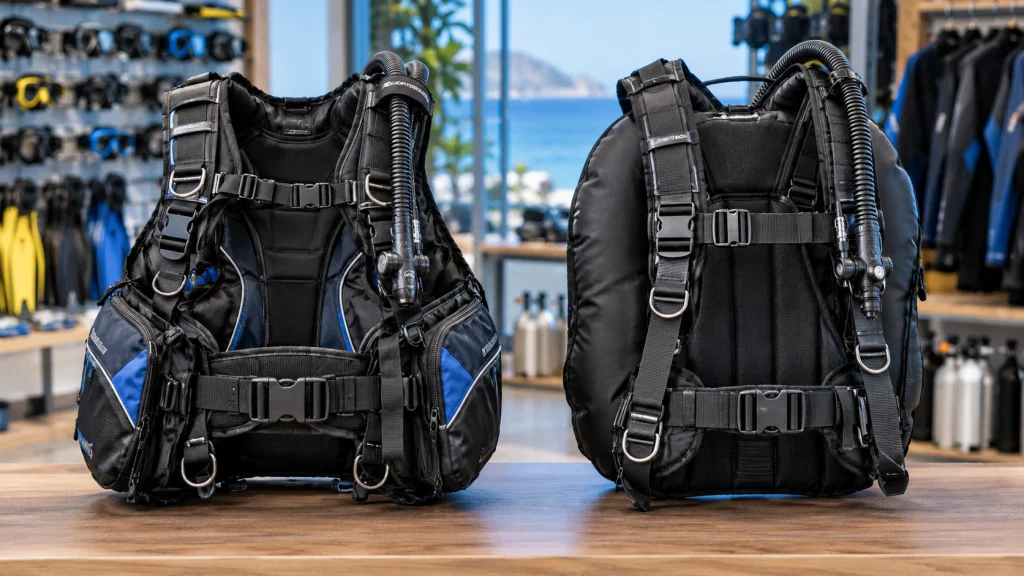
Jacket vs back-inflate BCD is one of the key comparisons when choosing scuba buoyancy equipment. Jacket styles distribute inflation around the torso, while back-inflate designs position most of the air cell behind the diver. Both can be suitable for recreational diving, but comfort, fit, configuration and training matter more than choosing a universally “best” style.
What a BCD does
A buoyancy control device helps the diver manage buoyancy by adding or releasing gas from an inflatable bladder. It also supports the scuba cylinder and carries parts of the equipment configuration. Its usefulness depends on a correct fit, suitable lift capacity and effective operation of inflation and dump mechanisms. It is not a replacement for proper weighting, breath control or buoyancy training. Diving conditions, exposure protection and the behavior of the cylinder throughout a dive all influence buoyancy. A BCD should be selected within the training and configuration a diver understands, rather than on looks alone. PADI identifies an expandable bladder, inflation mechanism, deflation system, adjustment hardware and cylinder attachment as standard BCD features.
How a jacket-style BCD works
A jacket BCD distributes the inflatable bladder around the torso, often extending around the sides. Many recreational divers have trained with a similar design at dive centers, so the arrangement can feel familiar. Inflating the jacket at the surface may provide a comfortable, upright floating position for some divers, but this depends on fit and configuration. Inflating it fully should not create painful squeezing across the chest. Try the BCD with the actual wetsuit or drysuit you plan to wear and examine how its straps and cummerbund adjust. A jacket may offer integrated pockets and accessory attachment points, but the availability and size of each feature vary by model.
How a back-inflate BCD works
A back-inflate BCD places most of the expandable bladder behind the torso. This can leave the front and sides less encumbered, which some divers prefer when swimming horizontally. A different surface-floating feel is possible because the location of buoyancy changes. That is not proof that a back-inflate BCD is universally better underwater or that all wearers will tip forward on the surface. Fit, weight distribution, inflation level and body position can all alter the experience. A diver considering a change from a jacket should try an appropriate model in supervised, controlled conditions and learn its operating characteristics before more demanding dives.
Comparing the two styles fairly
The jacket and back-inflate labels describe bladder location, not total product quality. Both styles can offer competent buoyancy control when properly fitted, maintained and used by a trained diver. The better choice depends on how it feels with your actual cylinder, exposure suit and weighting setup. Some divers prefer the familiar surface support of a jacket, while others value the uncluttered chest area of a rear-mounted air cell. Do not judge a BCD using only manufacturer claims about trim or streamlining. Its fit when partially and fully inflated, ease of dumping gas, access to releases and compatibility with the rest of your scuba system are all relevant.
Fit and comfort before features
PADI recommends trying on multiple sizes and, where appropriate, wearing thick exposure protection during fitting. Adjust the harness and check the inflation and deflation mechanisms using the manufacturer’s fitting and pre-dive procedures. Assess restriction without forcing the bladder beyond its intended inflation. Shoulder straps should be secure without restricting breathing or movement. The waist arrangement should hold the unit in position without excessive compression. Adjustability alone does not guarantee fit, because two BCDs can place attachment points differently. A BCD that rides up or cannot be fitted comfortably should not be chosen solely for its price or accessory list. Seek knowledgeable assistance with unfamiliar harness arrangements.
Lift capacity and appropriate configuration
Manufacturers publish lift-capacity specifications, but the required amount depends on the equipment system, exposure protection, cylinder choice and diving conditions. A larger lift figure is not automatically safer or more suitable. Excessive equipment bulk and an unsuitable configuration can create problems despite generous specifications. Recreational single-cylinder needs differ from technical, sidemount or multiple-cylinder requirements. Avoid deriving a universal lift recommendation from body weight alone. A qualified instructor or dive professional can assess the complete setup and ensure it fits the dives for which the diver is trained. Check that the advertised lift applies to the exact BCD size or variant being purchased.
Inflator, dump valves and hoses
A BCD must let its user add and release gas predictably. PADI lists low-pressure inflation, oral inflation, deflation and an overpressure valve among standard equipment features. Check inflator hose compatibility with the regulator configuration, as PADI recommends. The position of exhaust valves differs by model, so the diver needs to understand how to vent gas from the actual unit and body orientation. Examine the controls while wearing gloves if those are part of the intended setup. Unreliable inflation, a stuck valve or damaged hose is a reason to stop and seek qualified service. Do not attempt unapproved internal modifications to life-support-related equipment.
Integrated weights and release access
Some BCDs include integrated-weight pockets; others work with separate weight systems. Integrated weights can reduce reliance on a belt, but only when the system is used according to its manufacturer’s design and the diver’s training. Check each pocket’s rated capacity, the security of its locking mechanism and whether emergency release is accessible. A salesperson’s demonstration in an empty shop is not enough if the equipment becomes difficult to reach with thick gloves or a full suit. Confirm that the selected model includes the weight pockets pictured in the listing, rather than assuming that accessories are standard. Weighting should be established through appropriate training and in-water checks, not guessed from the BCD’s stated lift.
Travel and packing considerations
A travel BCD often emphasizes lighter construction or packability, but these qualities should not replace correct fit or reliable operation. Compare the exact model’s published weight, packed dimensions and accessory requirements. A very lightweight unit may be convenient on flights, while a more substantial harness may better suit another diver’s needs. Neither is inherently superior. Consider whether a rental cylinder is compatible with the BCD’s tank attachment and whether a destination operator has configuration requirements. Protect inflator hardware and buckles in transit. A lightweight claim may refer to a particular size without attached weight pockets, so inspect the manufacturer documentation before relying on it for luggage planning.
Jacket versus wing and backplate systems
Back-inflate recreational BCDs and backplate-and-wing systems are related but not identical. A recreational back-inflate BCD may have a familiar padded harness and integrated accessories. A modular backplate-and-wing system separates the backplate, harness and bladder, allowing selected parts to be configured for particular applications. That flexibility requires an understanding of component compatibility, harness adjustment and the diving configuration. A new recreational diver should not assume that modularity alone makes a technical-style setup the better purchase. Different systems can require additional training, practice and maintenance knowledge. Compare the exact intended use, not just the visual similarity of rear-mounted bladders.
Try-before-you-buy checks
Begin by trying the BCD over your expected exposure protection. Confirm that you can move both shoulders, breathe comfortably and reach all familiar controls. Adjust buckles and test the inflation/deflation actions according to retailer and manufacturer guidance. Check the cylinder-retention arrangement and make sure its compatibility is understood. Do not conduct an improvised pressure test or connect incompatible parts. If a controlled pool trial is offered under suitable professional supervision, compare how the unit feels at the surface and in a normal swimming position. Note any uncomfortable shifting, restricted movement or difficulty finding a valve. A BCD that fits well standing up can feel different when inflated and submerged.
Inspection and servicing
DAN recommends inspecting BCD fabric, seams, stitching, buckles, inflator assemblies, dump valves and air retention. It also advises periodic professional inspection, with an annual service benchmark in its equipment guidance. Manufacturer requirements may be more specific and should govern the service schedule. Fully inflate a BCD as the manual directs to check that it holds air, and inspect for obvious leaks or damage before use. If a hose shows cracking or an inflator does not operate correctly, do not dive with it until it has been evaluated appropriately. A BCD is not made safe merely by looking clean. Keeping service records can make it easier to identify when components were last assessed.
Rinsing and storage
After diving, PADI recommends rinsing the BCD outside and inside with fresh water according to the product instructions, drying it out of direct sunlight and storing it partially inflated in a cool, dry place. Remove weights before storage. Internal bladder cleaning must follow the relevant manual because components and valve arrangements differ. Do not use unapproved cleaners or force water into parts not intended for disassembly. Check that the unit is dry before long-term storage and avoid crushing the bladder under heavy equipment. Regular inspection remains important after storage, particularly if the gear has been unused for months. A comfortable fit and sound inflation system are more important than cosmetic appearance.
Common buying mistakes
The first mistake is choosing based only on a ranking or sale price. Another is buying a size without trying it over the exposure suit normally worn. A third is misunderstanding the difference between a recreational back-inflate BCD and a modular wing system. Also avoid relying on an impressive lift number without assessing the entire equipment configuration. Do not assume every BCD includes integrated weights, compatible inflator fittings or identical cylinder attachment systems. Look at the exact model and regional package contents. Be cautious about used gear with an unknown service history, and do not interpret an undamaged exterior as proof that internal valves and seals are functioning properly.
Which style should a beginner choose?
Many beginners learn with a jacket-style BCD and may prefer its familiar layout, but there is no rule that every beginner must buy that style. A well-fitted recreational back-inflate unit can also be considered when training and shop support are suitable. Renting different models before purchasing may clarify personal preference. The important questions are whether the diver understands the controls, can adjust the fit correctly, can secure the cylinder and can manage buoyancy within the limits of training. An instructor’s assessment of the diver’s complete setup is more meaningful than a generic internet recommendation. Both designs demand practice and maintenance.
Final decision checklist
Identify the environments you normally dive, the exposure protection you wear and the cylinder setup you use. Decide whether you prefer a jacket’s distribution of buoyancy or a back-inflate design’s rear air cell. Try more than one size, test adjustments and confirm inflation and exhaust access. Review published lift specifications and package contents for the exact variant. Check hose compatibility, tank attachment, weight system and available service support. Ask what is required to maintain the unit over several years. Before any demanding dive, become familiar with its behavior under appropriate training conditions. The right BCD is one that works predictably with your entire equipment system, not simply one whose specifications look impressive. Compare the harness, weight-release and packing arrangements in our six-model BCD guide once those requirements are clear.
Sources and related equipment guides
For further reading, consult PADI’s buoyancy control device guide, PADI’s beginner BCD comparison and Divers Alert Network’s equipment inspection guidance. Explore the GearDeep BCD category and scuba equipment explainers. This article discusses equipment selection and does not replace scuba training or model-specific manufacturer procedures.
About the author
Robert
Robert bohat acha bacha hay