By GearDeep Editorial · Updated
Dive light lumens vs beam angle is a comparison between how much light is emitted and where that light goes. Lumens describe total visible light output; beam angle describes its spread. A high-lumen flood and a lower-output spot can look very different on the same subject. Choose around the task, conditions, usable runtime and the complete light, rather than assuming the largest output figure is the best purchase.
What a lumen figure tells you
The lumen is a measure of luminous flux, commonly used to describe a light’s total visible output. For a dive light, the published number may refer to a particular operating mode. Check whether it is a maximum, a temporary high-output setting or another stated level. The figure alone does not tell you the beam pattern or how long that output is maintained.
Treat a manufacturer figure as a reported specification, not a GearDeep test result. Comparing two numbers is useful only when you understand the conditions behind them. If one listing combines a maximum output from one mode with runtime from another, write those details separately. Otherwise a convenient summary can create an expectation the documentation does not support.
What beam angle adds
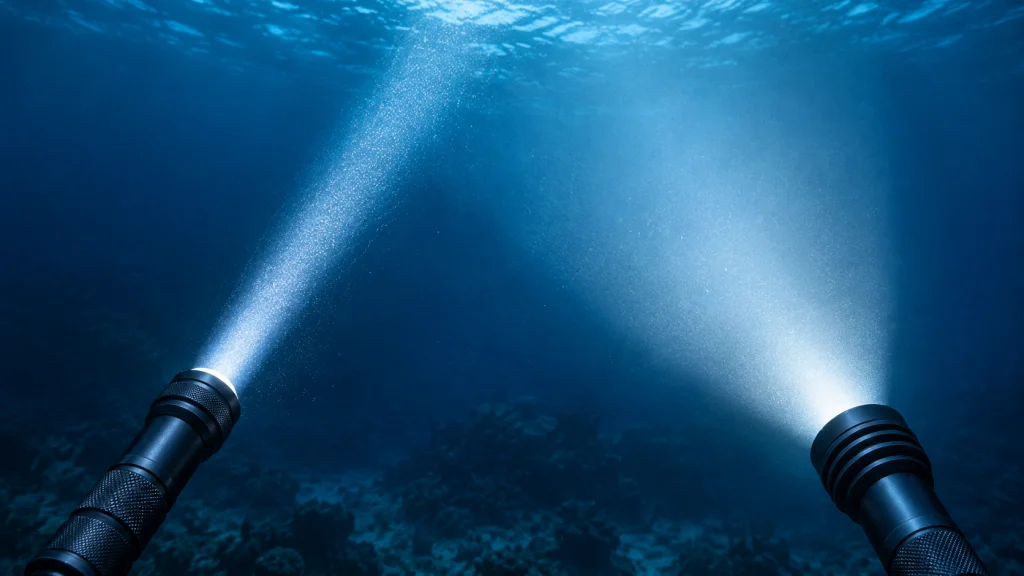
Beam angle describes the spread of the light. A narrow spot concentrates illumination over a smaller area, while a broad flood spreads it across a larger one. Real beams can also have a brighter central region and dimmer surrounding spill. A single angle may not describe all of that structure.
Read how the manufacturer defines the angle and whether different modes use different optics. A spot-plus-flood model might publish two angles, two output figures and separate operating controls. Do not combine the spot’s concentrated appearance with the flood’s total output as though they describe one mode. Compare the mode you intend to use for the particular task.
Why two lights with equal lumens look different
Imagine two hypothetical lights with the same reported total output. One sends it through a narrow beam, the other over a much wider field. At an appropriate distance, the first can put more light into a small target area, while the second illuminates more of the surroundings. This is a conceptual example, not a measured comparison of commercial products.
The useful effect depends on distance, water conditions, beam shape and the subject. A bright-looking spot on a nearby wall is not proof of superior navigation performance or a longer useful reach underwater. Conversely, a broad beam that looks less intense at its center may be doing exactly the job intended for a close, wide subject.
Lumens and intensity are different quantities
Some specifications also give candela, a measure of luminous intensity in a direction. That can help describe how concentrated a beam is, but it still needs context. A manufacturer’s land-based beam-distance figure should not be read as underwater visibility. Water absorbs and scatters light, and conditions vary greatly.
Avoid turning a technical quantity into a universal diver-safety threshold. Neither a lumen value nor an intensity figure establishes what a diver can safely do in an unfamiliar environment. Use them to understand equipment characteristics, then select and practice with the light in conditions appropriate to your training and the planned use.
Spots for focused observation and communication
A concentrated beam can be useful when you want to direct attention to a small area or see a distinct spot. Its suitability for communication depends on the signals and procedures taught for the diving you do. A product’s ability to make a bright spot does not establish the correct signaling method.
Try the control layout and carrying arrangement with the gloves you will wear. A beam that suits the task is less useful if cycling through modes is awkward or the switch cannot be identified reliably. Do not first discover a new light’s control sequence on a demanding dive. Beam selection and practical handling should be assessed together.
Floods for wider close-range coverage
A broad beam can help illuminate a wider nearby scene, including some photographic or video tasks. That does not make every flood an ideal camera light. Beam uniformity, color characteristics, mounting compatibility and the camera setup all matter. A handheld recreational light and a dedicated video light may solve different problems despite similar output figures.
If lighting imagery is your priority, compare documentation for that exact use. Consider whether a central hotspot will be visible in the frame and whether the mount suits the equipment. Do not assume a wide beam can replace every role of a primary recreational or specialized dive light. The equipment plan still needs the appropriate independent lighting arrangement.
Particles change what the beam reveals
Suspended material can make reflected or scattered light prominent between you and the subject. Simply increasing output is not guaranteed to improve the useful view. Beam placement, viewing direction and water conditions affect the result. The behavior you see in a clear swimming pool can differ from that in a silty or particle-rich environment.
Treat demonstrations and photographs with care. Exposure settings can make one beam look brighter, and different water clarity can overwhelm a small difference between products. If a comparison does not control those factors, it should not be presented as a measured ranking. For your own familiarization, use appropriate conditions and instructor guidance where needed.
Match runtime to the selected mode
Find the output level associated with each runtime statement. A long burn time at low output does not establish the duration of the brightest mode. Also check whether the maker describes declining output, step-down behavior, a regulated level or a low-battery indication. A light remaining visibly on is not necessarily maintaining the performance you intended to use.
Plan the primary and backup around their roles and your training. Do not use this article to invent a universal runtime margin for every dive. Our primary and backup light guide discusses independent roles, while battery and charging guidance explains why the approved power system belongs in the comparison.
Adjustable beams introduce another set of controls
An adjustable-beam or dual-beam model may cover more than one task, but inspect how the change is made. Can you identify the control with gloves? Does a mode sequence require passing through settings you do not want? Are the beam angles and runtime figures documented separately?
More modes create flexibility only if the diver can use them appropriately. A simple fixed beam may suit a defined task better than a complicated arrangement, while a well-designed multi-mode light can be useful for someone who needs that range. Compare function and familiarity rather than counting modes as though every additional setting improves the purchase.
Depth rating is a separate specification
Neither lumens nor beam angle tells you whether the housing is suitable for the intended depth. Check the exact light’s operating rating, closure requirements and any restrictions. General “waterproof” wording or a splash-resistance claim is not a scuba depth specification. Product families and similarly named versions may differ.
The rating describes equipment capability under the maker’s conditions; it does not authorize a diver to go to that depth. Keep certification, experience, environment and the dive plan separate from the housing specification. If documentation conflicts, seek clarification rather than selecting the larger number from a retailer’s title.
Use manufacturer examples without mixing their claims
OrcaTorch’s D710 page identifies a narrow beam alongside several output choices. It is an example of why the beam and mode need to be read together, rather than treating the largest lumen number as the whole description. GearDeep has not independently measured this model’s output or beam.
Other lights use separate wide and narrow modes. Read their actual tables and manuals because the mode names alone do not establish equivalence. If a table and the accompanying text disagree, record the discrepancy and ask the manufacturer. A comparison becomes more useful when it acknowledges uncertainty instead of smoothing conflicting figures into one confident row.
Look for a complete beam description
When a listing gives only lumens, ask for the manufacturer’s beam information before deciding that two lights are comparable. A photograph of a bright circle on a wall may help illustrate a pattern, but the camera exposure and distance can change the impression. A drawing of a cone may be descriptive rather than a measured intensity map.
For a real shortlist, record what is known and what is missing. One candidate may have clear mode-specific documentation, while another has only a headline output claim. That difference matters even before considering price: the better-documented option lets you judge whether the design fits the intended role. It does not prove greater performance, but it reduces the amount of guessing in the purchase decision.
Build a comparison around your task
For each candidate, record intended role, beam arrangement, usable output modes, matched runtime information, battery type, controls, mounting and depth rating. Keep unknowns visible. Then ask which features change your actual decision. A camera user may need broad coverage; another diver may prioritize a defined spot and accessible backup arrangement. The six-light buying comparison keeps beam wording, output modes and supplied power arrangements visible beside each model.
PADI’s dive light overview introduces primary and backup styles and power choices. Use that context alongside exact documentation and appropriate familiarization. The useful purchase is the light whose beam, power system and handling suit the planned role, rather than the one with the most impressive number in its listing title.
About the author
Robert
Robert bohat acha bacha hay