
By Robert · Updated
The analog SPG vs air-integrated dive computer decision concerns how you read cylinder pressure, what powers the instrument and how the system connects to your regulator. Both support a gas-management plan; neither replaces it. Compare readability, compatibility, service requirements and your response to a loss of pressure information before changing the equipment you use.
What an analog SPG actually measures
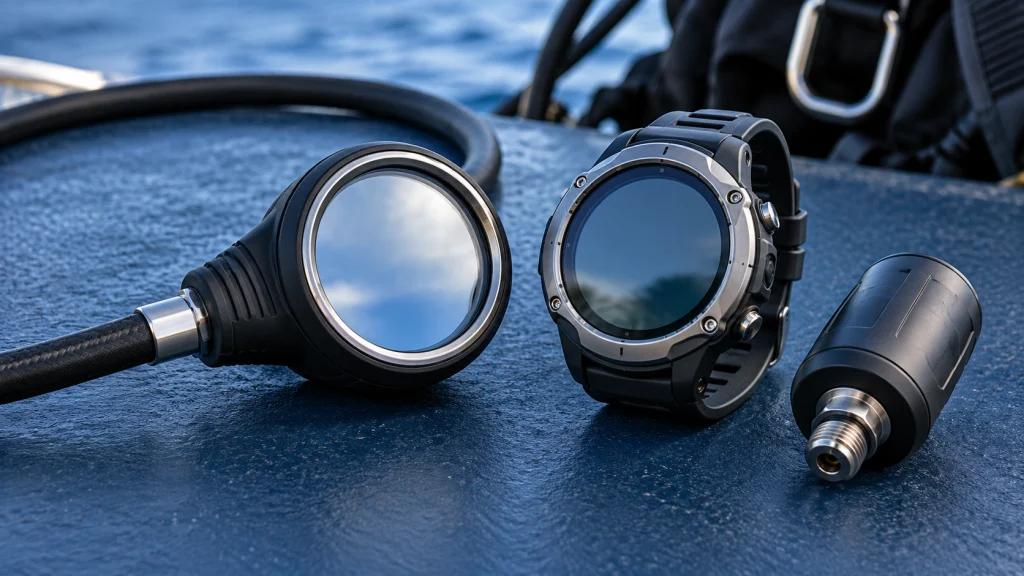
An analog submersible pressure gauge is an instrument connected through a compatible high-pressure hose to the regulator first stage. It displays cylinder gas pressure through a dial, usually marked in bar or psi. Divers use it to track remaining pressure and manage gas according to their training and plan. The indicated pressure is not automatically a universal number of breathable minutes because consumption depends on conditions, depth and individual breathing demand. A mechanical dial can be straightforward to read, but hose routing, gauge condition and unit familiarity matter. Check the instrument as part of the full regulator setup, not as a standalone accessory with interchangeable fittings.
How air integration works
Air-integrated dive computers display cylinder pressure using a compatible electronic connection. Some systems use a wireless transmitter attached to the first stage; others use a hose-based connection or integrated console. PADI describes these arrangements as optional dive-computer features. A transmitter does not make every dive computer compatible with every regulator or computer firmware version. Verify the exact brands, models and connectors involved. The pressure reading still supports a gas-management plan rather than replacing one. Wireless models also introduce battery, pairing and signal considerations that users must understand before depending on them.
The strengths of a mechanical gauge
An analog SPG does not require a battery in the gauge itself and often offers a direct visual indication of cylinder pressure. Some divers appreciate the predictable display and simplicity when conducting a quick equipment check. That simplicity does not eliminate the possibility of mechanical damage, hose leakage or incorrect readings. The connection remains part of a high-pressure gas system requiring appropriate inspection and service. A dial that is hard to read underwater may be less useful than its straightforward design suggests. Consider scale size, contrast, markings and how the gauge will be secured while swimming.
The strengths of air integration
An air-integrated computer can place cylinder-pressure information beside depth, dive time and other relevant readings, potentially reducing the need to reach for a separate gauge. Certain models offer gas-consumption estimates or alerts, depending on the manufacturer and settings. These estimates still depend on assumptions and cannot replace planned reserves or monitoring. Display convenience is useful only when the screen remains legible and the transmitter connects reliably. Evaluate which pressure fields appear automatically and what happens when the radio link or battery fails. Do not buy an air-integrated model solely because its marketing mentions advanced calculations.
Pressure units and readability
Both analog and electronic instruments may present pressure in bar or psi. Check the units before diving and confirm they align with your training and the gas-planning method being used. Confusing bar with psi can create a serious misunderstanding. On analog gauges, inspect needle movement and scale readability. On electronic displays, verify font size, lighting, screen layout and unit settings. Glare, poor vision or gloves may change which instrument is easier to use. Readability is personal; a compact computer is not automatically more legible than a well-positioned mechanical dial.
Gas management is the essential skill
Neither instrument tells you that continuing a dive is safe merely because pressure remains in the cylinder. Gas planning incorporates the dive profile, buddy needs, reserve requirements and environmental conditions, using methods taught through certification. Pressure should be checked at appropriate intervals and communicated with a buddy in the agreed way. A diver must not substitute an automated ‘time remaining’ estimate for understanding gas consumption and reserves. If you are learning air integration, practice interpreting the display on land and in suitable training conditions before using it in a demanding dive. The equipment supports awareness; training determines how that information is used.
Wireless pairing and compatibility
Transmitters have specific protocols and manufacturer restrictions. An accessory advertised as a wireless tank-pressure sensor does not necessarily pair with the computer you own. Consult the current compatibility chart for the exact hardware and firmware version. Learn whether pairing is required before every dive and how the unit handles multiple transmitters. If your system supports more than one gas source, understand its labels and switching procedures under appropriate training. Avoid attaching equipment to a regulator high-pressure port without qualified help and manufacturer confirmation. Mechanical compatibility and digital pairing are separate questions, and both must be resolved.
What happens when electronics fail
A transmitter may lose connection, its battery may run low, or a computer may become unreadable. Understand the manufacturer’s failure indications and apply the contingency procedures taught for your type of diving. Some divers choose a separate analog pressure gauge as a backup, but the appropriate configuration is determined by training, diving environment and the full system. The presence of a backup is only useful when it is accessible, functioning and understood. Do not ignore an unexplained loss of pressure data or assume that a previous displayed value remains current. Resolving such failures underwater requires training-based decisions, not improvisation from an online guide.
Hose routing and snag management
An analog SPG is normally connected by a hose, so routing affects accessibility and the potential for dragging or snagging. Secure the gauge where it can be reached when needed and keep it from contacting sensitive habitat. A hose should not be pulled taut or sharply bent. Wireless transmitters reduce the need for a separate pressure-gauge hose in certain configurations but remain physical attachments vulnerable to impact or improper handling. Positioning a transmitter incorrectly may create clearance issues around the first stage and valves. Have the complete configuration checked by a qualified dive professional when installing or changing pressure-monitoring hardware.
Care and inspection of the pressure system
Inspect hoses for visible damage and gauges for cracks, fogging or abnormal behavior, using manufacturer and professional service guidance. DAN’s equipment guidance emphasizes assessing regulator hoses and instrument condition before diving. A leaking high-pressure connection or damaged hose is not a do-it-yourself adjustment opportunity. Stop using the assembly until qualified personnel assess it. For air-integrated systems, inspect transmitter condition, approved battery service status and connection integrity. Rinsing and storage follow the instructions of the specific components, which may differ in their water-resistance and seal requirements.
Cost and ownership considerations
An analog SPG may be less expensive than adding a compatible air-integration transmitter and premium computer, but actual ownership cost depends on models, service and replacement requirements. Avoid presenting a fixed price advantage without checking the products in the intended market. A sophisticated electronic display may offer convenience that some divers value, while others prefer a straightforward mechanical indication. Consider what gear you already own, whether transmitter batteries are serviceable locally and what maintenance support is available during travel. A product requiring expensive accessories or limited regional service may be less practical than its specification sheet suggests.
Which option suits a beginner?
A beginner should prioritize an instrument arrangement consistent with training, easy to read and simple to check alongside a buddy. A properly maintained analog SPG is a conventional option. Air integration can also be appropriate if the diver learns its configuration, controls and failure behavior. No beginner should assume that buying a costly computer removes the need for routine pressure monitoring and reserve planning. Ask the instructor or dive center to demonstrate the exact configuration, including where the pressure indication is located. Familiarity with the chosen system is more important than choosing whichever technology looks newest.
Choosing for travel and different regions
Divers who travel with their own computer but rent regulators may encounter compatibility limitations. A wireless transmitter cannot necessarily be installed on a rental first stage without approval and professional assistance. A gauge already attached to rental equipment may use a different unit system from the diver’s home setup. Confirm the rental configuration before the trip and ask what monitoring instruments are provided. Avoid assuming a personal transmitter can be moved between regulator systems at will. For regular travel, simplicity and predictable servicing may matter more than adding technical features that cannot be used reliably at the destination.
Common misunderstandings
An analog gauge is not guaranteed to be accurate forever because it lacks a battery. Wireless air integration does not remove the need for gas planning. An electronic remaining-air estimate is not a promise of breathable minutes under all conditions. Transmitters are not universally interchangeable, and a gauge attached to a hose is not automatically compatible with every regulator port. A small gauge is not necessarily easier to use than a larger display. The correct comparison is about verified compatibility, readable pressure information, serviceability, risk management and what the trained diver can use confidently.
Frequently asked questions
Can an air-integrated computer replace an SPG? Some configurations do, but suitability and backup arrangements depend on training and the diving environment. Does an analog gauge need a battery? The mechanical gauge itself generally does not. Are pressure readings the same as remaining dive time? No. Can a transmitter pair with any computer? No; verify exact compatibility. Should a diver carry two independent pressure indications? Backup strategy depends on training and the full equipment system. What if pressure readings disagree? Treat unexplained discrepancies as equipment concerns requiring appropriate professional attention and training-based response.
Practical final checklist
When updating pressure-monitoring equipment, verify the compatibility of the regulator first stage, high-pressure ports, transmitter and computer, or the specification of the analog hose and gauge. Installation and servicing of high-pressure gas components should be handled by appropriately qualified people. Regardless of display method, gas-management plans and contingency decisions remain part of training. For an analog replacement, our scuba pressure gauge comparison separates bare instruments and protected packages; the dive computer guide covers the separate air-integration choices.
Sources and related GearDeep guides
Primary reference: PADI dive computers and air integration. Browse related pressure gauges guides and scuba equipment explainers. GearDeep does not claim to have tested the equipment described here. Training and exact manufacturer guidance control safety-critical decisions.
About the author
Robert
Robert writes about scuba-diving equipment for GearDeep, focusing on fit, compatibility and the practical differences between products. His buying guides use manufacturer specifications and manuals to help readers compare their options, understand important limitations and make informed equipment choices.