By GearDeep Editorial · Updated
Amazon Affiliate Disclosure: As an Amazon Associate I earn from qualifying purchases. This comes at no extra cost to you. How affiliate links work.
The best scuba pressure gauges give you a readable pressure display in a configuration that matches your regulator and preferred units. The Mares Mission 1 is our first choice to compare if you want a protected, pressure-only console. The other five options cover compact gauges, a larger brass-and-glass dial and modular arrangements, with hose and package details worth checking before you buy.
The short answer
Quick Verdict
Our top pick is the Mares Mission 1 for its protected pressure-only layout. A brass gauge, phosphorescent dial and three attachment eyelets make it a practical starting point. Confirm the units and included hose in the exact offer; no gauge in this comparison should be ordered from its photograph alone.
- Cressi Mini SPG Vale 300 C or SCUBAPRO Compact SPG 400 B: compare these if a small metric gauge is the priority.
- Highland 2-inch Brass & Glass: the larger-face option with a tempered-glass lens.
- Highland Thin Line: a slimmer gauge body with separate unit versions.
- Suunto SM-36: investigate it when compatibility with a supported Suunto console arrangement matters.
For our selection process, read How We Research.
On this page
Scuba Pressure Gauge Comparison
Compare the features that affect your purchase, then check the selected listing for the current price, version and package contents.
| Model | Best For | Dial / Units / Housing | Main Purchase Check | Price / Where to Buy |
|---|---|---|---|---|
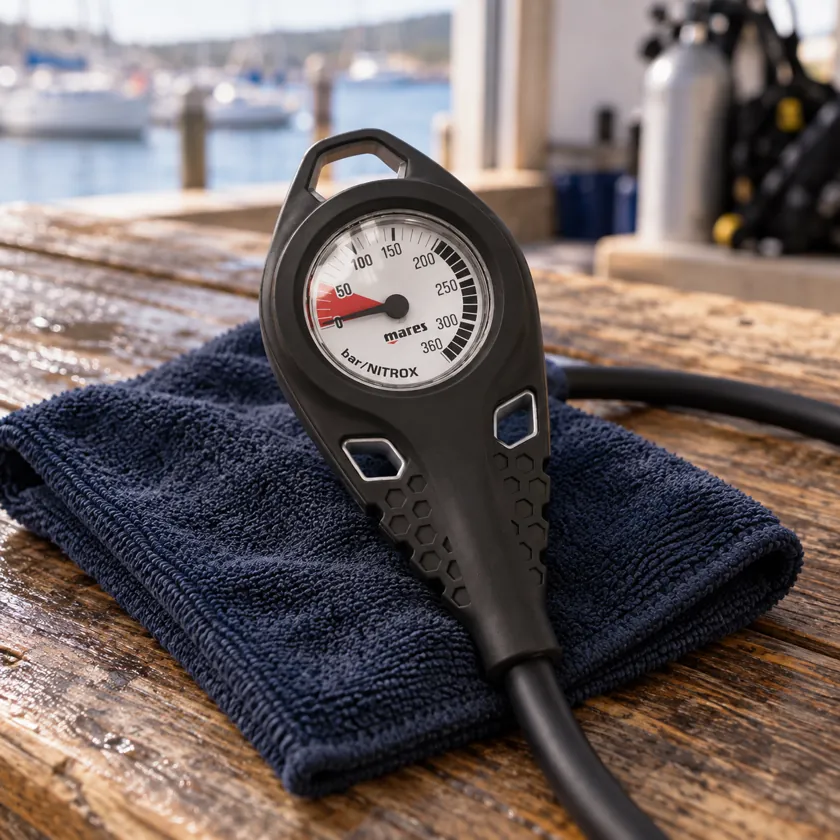 Mares Mission 1 | Protected Console | Pressure-only; phosphorescent dial; protective console | Units, included hose and attachment layout | Check price on Amazon |
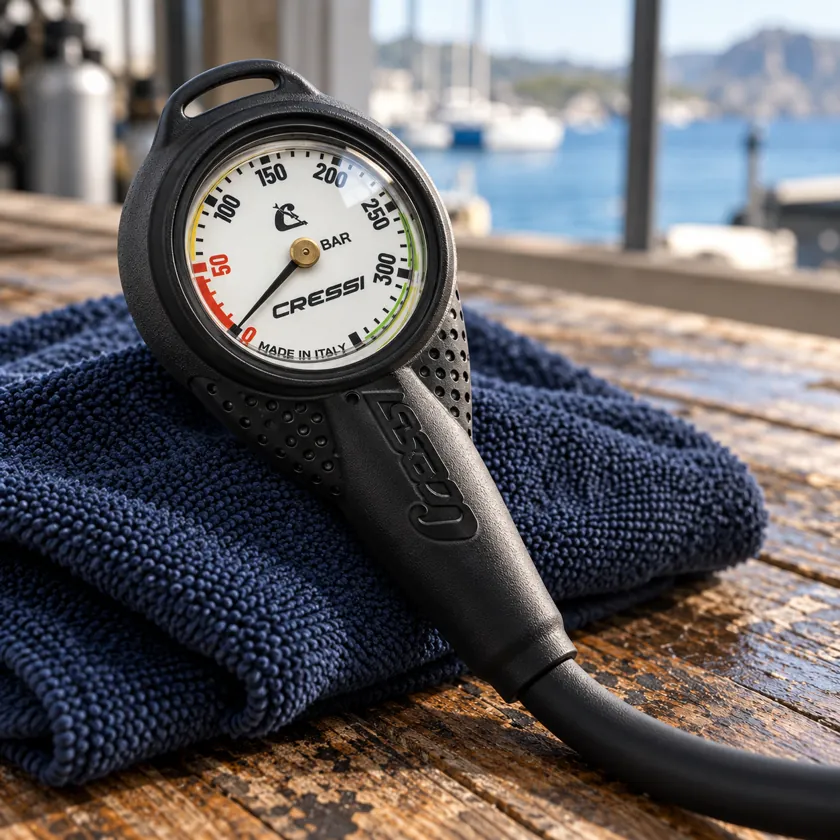 Cressi Mini SPG Vale 300 C | Compact Metric Alternative | Compact; bar; brass case and rubber boot | Vale 300 C metric face and hose contents | Check price on Amazon |
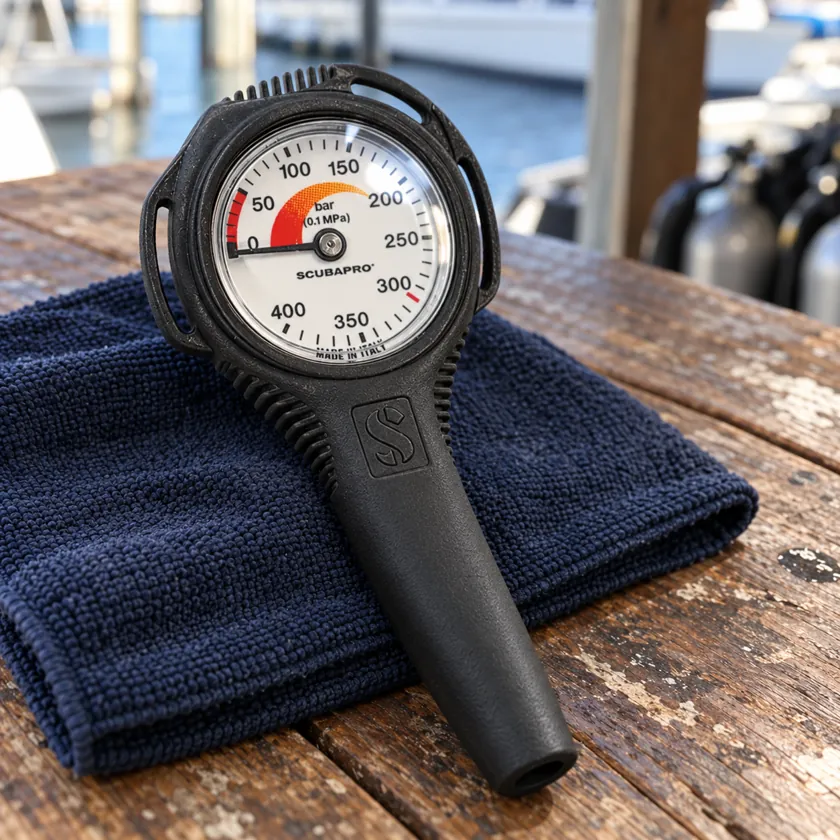 SCUBAPRO Compact SPG 400 B | a Compact 400 Bar Dial | Compact; 0–400 bar; protected brass gauge | Exact 28.039.300, face and hose package | Check Amazon listings |
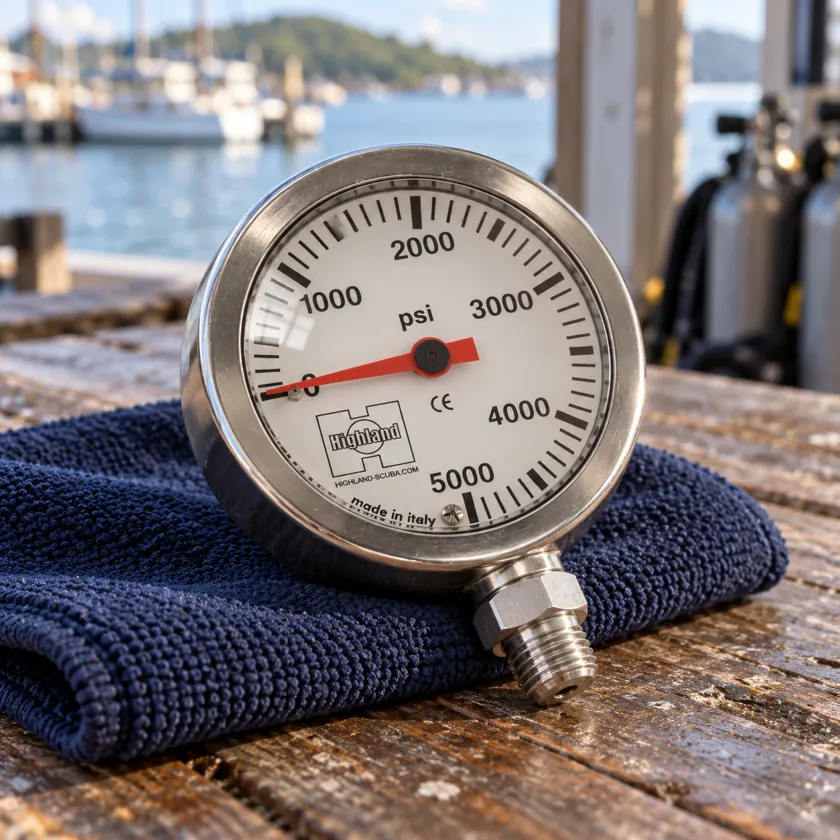 Highland 2-inch Brass & Glass SPG | a Larger Brass-and-Glass Dial | 2 in; brass body; tempered-glass lens | Unit version, 2-inch model and separate hose | Check price on Amazon |
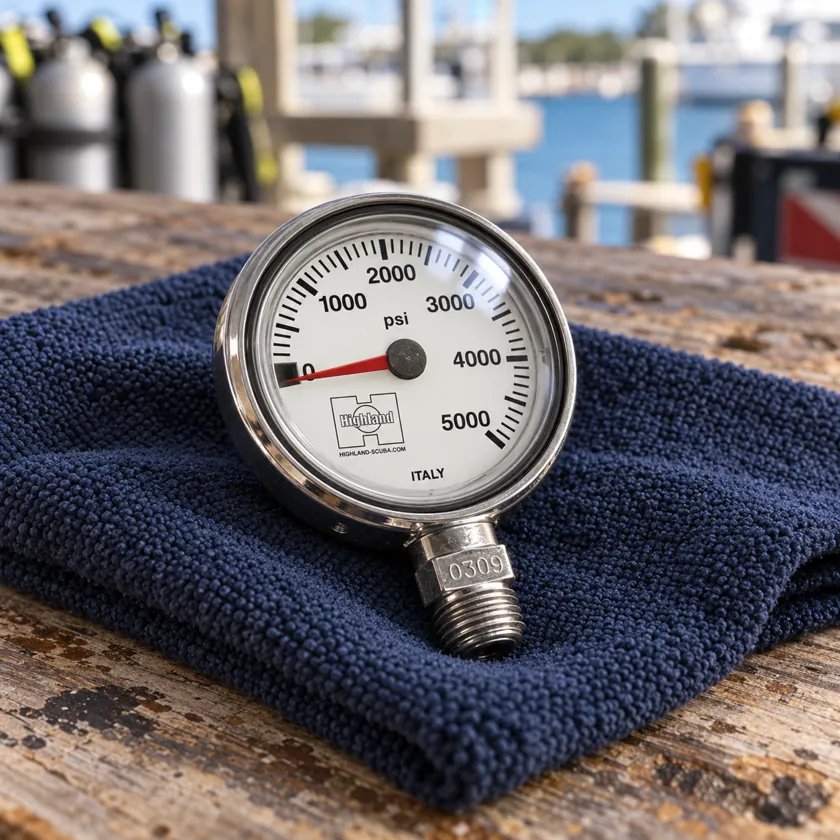 Highland Thin Line SPG | a Slimmer Gauge Body | Slim brass body; Lexan lens; psi or bar version | Selected units, hose and complete connection | Check price on Amazon |
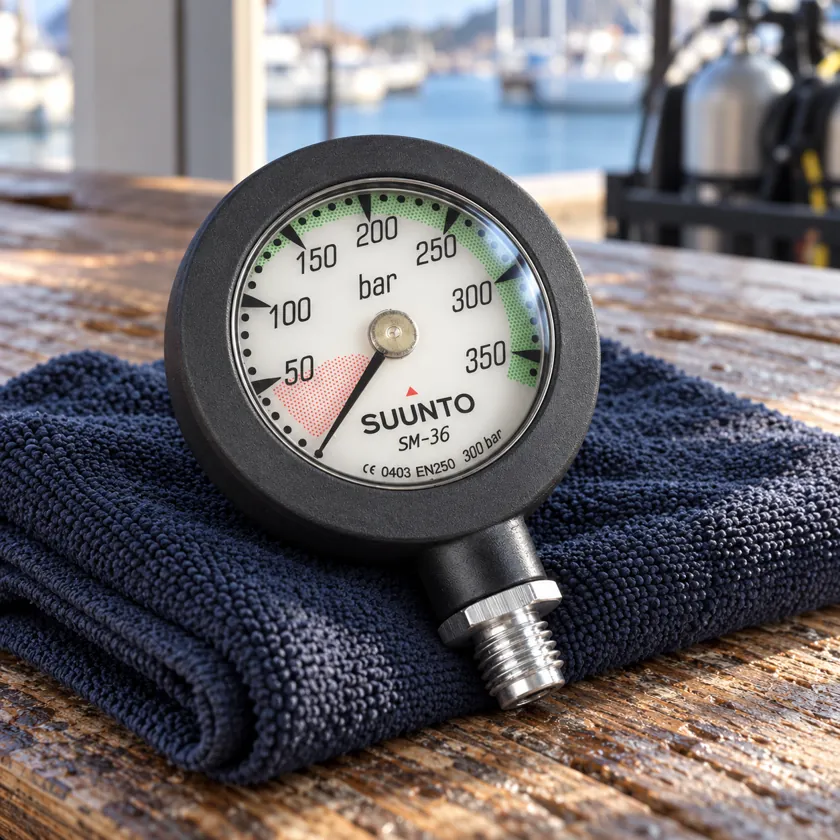 Suunto SM-36 | a Supported Suunto Console Setup | Suunto system module; bar or psi version | Exact module, units and supported assembly | Check Amazon listings |
Entries labeled “Check Amazon listings” open a search for that exact model; confirm a matching product and selected configuration before ordering.
1. Mares Mission 1 — Best Overall Protected Console
The Mission 1 is our first choice to compare for a protected pressure-only console. It keeps the instrument layout simple while providing a brass gauge, a phosphorescent dial and several ways to attach the housing.
Key Features
- Pressure-only analog console
- Brass gauge case
- Phosphorescent dial
- Color-coded markings
- Protective console housing
- Three attachment eyelets
Why It’s Our #1 Pick
The Mission 1 takes first place because it is a straightforward pressure-only console with a protective housing and several attachment points. It offers a practical balance for a diver who wants one clearly defined instrument rather than a larger multi-instrument console. The useful question is whether its dial and housing work well in your own equipment arrangement.
The brass gauge, phosphorescent face and color coding are features you can assess during a dry demonstration. Compare the actual unit markings in the light you have available and check how the console can be secured and read. The eyelets are helpful only if the chosen routing keeps the gauge accessible without leaving it dangling.
It is not a claim that the Mission 1 is more accurate than the other gauges. The exact units, hose package and regulator compatibility still need confirmation, and your personal gas plan determines reserve decisions. If you prefer a different dial size or housing, one of the compact or Highland options may suit you better.
What to Consider
Compare it with the Cressi using the same reading task and the same available lighting conditions. Note numeral spacing, pointer contrast and whether the protective boot obstructs the view at an angle. A dry demonstration is useful for your purchase decision, but it is not a measured underwater readability test. Obtain the exact manual and package information before choosing a hose configuration.
Pros
- Simple pressure-only layout
- Protective housing with multiple attachment points
- Dial design is easy to assess in a demonstration
Cons
- Regional unit versions need checking
- Housing takes more space than a bare module
- Package title must confirm the included hose
Who Should Buy It?
Start with the Mission 1 if you want a protected console and its dial, units and routing suit your regulator setup. Have compatibility confirmed before fitting it.
2. Cressi Mini SPG Vale 300 C — Best Compact Metric Alternative
The Cressi Mini SPG is worth comparing when you want a small metric instrument with a protective boot. Match the exact Vale 300 C version and face rather than interpreting the model name as the dial’s maximum scale.
Key Features
- Compact analog pressure gauge
- Metric version with a 350 bar dial scale
- Chrome-plated brass case
- Protective rubber boot
- Attachment loop
- Color-coded pressure markings
Why It Makes the Shortlist
The reason to try this design is a compact protected instrument with a clearly listed metric face. Inspect the actual dial with your normal vision correction and in the position you intend to carry it. A small body can reduce bulk while making markings less suitable for some readers. Neither compactness nor a color band tells you how readily you can identify a pressure value at a glance.
What to Consider
Compare it with the Mission 1 if you want a protected analog arrangement and with the protected Compact SPG 400B after accounting for package differences. Ask whether the actual offer supplies the hose and which approved assembly is intended. A product photo showing a long hose beside another console is not enough to establish the selected item’s contents.
Pros
- Small housing to compare for routing
- Protective boot and attachment provision
- Clearly defined metric version
Cons
- Small markings may not suit every eyesight need
- The 300 C name is not the maximum scale
- Hose contents depend on the selected offer
Who Should Buy It?
Consider the Cressi if a compact bar gauge fits your setup and you can read it comfortably. Confirm the exact face and hose package before ordering.
3. SCUBAPRO Compact SPG 400 B — Best for a Compact 400 Bar Dial
The Compact SPG 400 B is the small metric option to investigate if its dial layout works for you. Keep the exact model identifier in the comparison; a similarly named SCUBAPRO gauge may have a different face or package.
Key Features
- 0–400 bar dial scale
- 10 bar graduations
- Red zone below 50 bar
- Brass gauge case
- Protective housing
- Model reference 28.039.300
Why It Makes the Shortlist
The useful reason to investigate it is a specifically listed compact metric instrument, particularly where a supplier is assembling a supported configuration. The 10 bar graduations describe the dial layout, not an accuracy specification. A wide range also does not make every part of the scale equally easy for every reader to interpret. Inspect the actual face rather than assuming that a higher endpoint improves useful resolution.
What to Consider
Ask a qualified supplier to identify the exact gauge, protective housing, approved hose and connection arrangement in the selected offer. Compare its item number with the current documentation and establish which parts are supplied together. If you need a complete SPG assembly, compare complete listed assemblies rather than assuming that every product title ending in SPG describes the same package. A photograph alone cannot confirm the contents of a different regional offer.
Pros
- Specific metric scale and graduation layout
- Compact protected form
- Model identifier helps distinguish similar offers
Cons
- Fine graduations need a readability check
- Red zone is not a personal gas reserve
- Exact model and hose package may be hard to identify
Who Should Buy It?
Compare this model if you want a compact bar gauge and can clearly read the selected face. Use the model reference to check the offer rather than substituting a U-Line listing.
4. Highland 2-inch Brass & Glass SPG — Best for a Larger Brass-and-Glass Dial
The Highland 2-inch gauge is the option to compare if dial size and a glass lens matter more than the smallest possible housing. Confirm the unit version and plan for a compatible hose, which is not included in the gauge-only specification.
Key Features
- Nominal 2-inch gauge size
- Plated brass body
- Tempered-glass lens
- Luminescent face
- Wide pointer sweep
- Air spool included; high-pressure hose excluded
Why It Makes the Shortlist
The design belongs in a comparison when you want a bare brass-and-glass gauge assembled into a supported hose and retention arrangement. The absence of a large console boot can appeal to some configurations, but exposed construction is not a reason to neglect protection or handling. Material names alone do not establish scratch or impact resistance.
What to Consider
Compare the 2-inch face with the Thin-Line under the same reading conditions and check the exact imperial or metric version supplied. The manufacturer lists different unit options; do not present every item as a dual-scale face without confirmation. If a 2.5-inch face reads better for you, assess that actual size and its carrying arrangement rather than assuming the smaller one is automatically the more professional choice.
Pros
- Larger face to assess for readability
- Tempered-glass lens
- Clear gauge-only component information
Cons
- Hose adds to the complete purchase
- Larger body affects routing and storage
- 2-inch and 2.5-inch models are different
Who Should Buy It?
Try the Highland Brass & Glass if you prefer its larger face and glass lens. Match the units and connection, and include the proper hose in the complete setup cost.
5. Highland Thin Line SPG — Best for a Slimmer Gauge Body
The Thin Line is a different Highland configuration, with a slimmer body and a Lexan lens. Choose it for those dimensions and handling preferences rather than assuming it shares the Brass & Glass model’s construction.
Key Features
- Slim gauge-body design
- Nickel-plated brass body
- Lexan lens
- Luminescent face
- Separate 5,000 psi and 400 bar versions
- High-pressure hose excluded
Why It Makes the Shortlist
The Thin-Line is useful to compare when its physical profile, scale and lens arrangement suit the planned configuration. A polymer lens and a glass lens each need their own care and protection instructions. Ask for the approved cleaning method and inspect the actual face for readability rather than choosing a material from a broad slogan.
What to Consider
Compare it with the Brass & Glass on actual dial layout and the parts needed to finish the system. A bare gauge may look inexpensive until the supported hose, retention and installation are included. Conversely, buying a complete console may be unnecessary when an appropriately qualified supplier is preparing a different listed arrangement. The configuration requirement comes first.
Pros
- Slim profile to compare in the routed setup
- Separate unit choices
- Distinct alternative to the glass-lens model
Cons
- Lens material differs from Brass & Glass
- Hose must be selected separately
- Correct unit version needs explicit confirmation
Who Should Buy It?
Consider the Thin Line if its profile makes sense for your routing and you prefer its dial. Confirm the units and complete the purchase with compatible components.
6. Suunto SM-36 — Best for a Supported Suunto Console Setup
The SM-36 belongs on the shortlist when its supported standalone or Suunto console configuration fits your equipment. The module, units and hose must match; the family name alone does not identify a complete ready-to-use package.
Key Features
- Analog pressure-gauge family
- Separate 300 bar and 4,000 psi versions
- Supported standalone configuration
- Compatibility with specified Suunto Combo arrangements
- Module and hose must match the intended assembly
Why It Makes the Shortlist
The reason to consider the SM-36 is its listed integration into a compatible modular console or supported standalone arrangement. If you already own a Suunto console, identify the exact modules and fit requirements rather than assuming that every round instrument from the brand fits. A component supplied without a hose or quick-release arrangement cannot borrow the contents of a complete kit pictured elsewhere.
What to Consider
Ask the supplier to establish the correct instrument, hose and module combination. If the intended purchase is a pressure-only gauge, check whether a console system adds useful capability or unnecessary bulk for your kit. If you need a combined instrument arrangement, compare the actual assembled size and access. A brand match is the beginning of a compatibility check, not the result.
Pros
- Useful within a compatible Suunto system
- Distinct unit versions
- Configuration can be checked against the supported assembly
Cons
- A module listing may not be a complete gauge package
- Compatibility cannot be inferred from appearance
- Exact US offers can be difficult to identify
Who Should Buy It?
Investigate the SM-36 when you have a supported Suunto arrangement or a clearly specified standalone package. Confirm the exact module, units and hose through the supplier.
How to Choose a Scuba Pressure Gauge
Choose the units you use confidently, then compare dial readability, housing, routing and the exact high-pressure hose connection. A dial’s maximum scale is not the cylinder’s permitted fill pressure. Have regulator components and compatibility checked through the appropriate service route.
Six gauges with different purchase considerations
The shortlist is Cressi Mini SPG Vale 300 C, Mares Mission 1, SCUBAPRO Compact SPG 400B, Highland 2-inch Brass & Glass, Highland Thin-Line and Suunto SM-36. The two Highland designs are distinct products with different lens and scale specifications, not two colors counted separately.
These gauges are not all sold in the same package format. Some manufacturer records identify a console or protective boot, while others explicitly exclude the high-pressure hose. The first comparison is therefore what you receive and what must be supplied separately. A lower bare-gauge price cannot be compared fairly with a complete hose-and-boot package until the missing parts and installation requirements are established.
Begin with units, readability and the complete assembly
If a protected compact layout is the starting requirement, compare the current Cressi Mini SPG with Mission 1 while checking the actual face and package. Their housing and attachment arrangements are useful differences; a dial photograph cannot establish readability for your eyesight or gloves. Confirm the units and the intended hose contents before comparing their total purchase cost. The printed scale endpoint and any colored reserve band do not establish the working pressure or gas plan for the complete system.
If you are selecting a separate gauge for a professionally assembled configuration, compare the Highland Brass & Glass with Thin-Line for their actual lens, scale and unit-model differences. Both need the appropriate hose arrangement rather than an assumption that a bare-gauge price buys a complete installation. The protected Compact SPG 400B and modular Suunto SM-36 also need exact item and package identification. For an existing console, supported compatibility can settle the choice before diameter or materials do. Replace an unreadable or damaged instrument for the identified problem; a different brand alone does not demonstrate improved accuracy.
Choose units you can use consistently
Select bar or psi according to the equipment, training and operating environment you use. Familiarity and clear buddy communication matter more than declaring one unit system universally better. An instrument in unexpected units can create confusion during a routine check even when it is functioning properly. Make the selection deliberate and verify the face on the delivered item.
Do not rely on mental conversion during a demanding task if the equipment arrangement can be made consistent beforehand. A dual-scale face can be useful for some users while adding visual clutter for others. If choosing one, inspect the actual primary and secondary scales. A product page listing both metric and imperial versions is not evidence that both scales are printed on every single gauge.
Scale endpoint is not system working pressure
A face that reads to 350 or 400 bar describes the displayed range. It does not establish the approved working pressure of a hose, first-stage port, swivel or other component. The complete high-pressure arrangement must be suitable under the relevant manufacturer documentation. Do not use the largest number printed on one part as permission to exceed another part’s rating.
Likewise, model names such as 300, 4000 and 5000 can refer to different product or unit conventions. Read the specification and manual rather than selecting a pressure limit from the title. Filling and pressure testing belong with qualified facilities and suitable equipment.
Readability involves more than diameter
Look at numeral size, tick spacing, pointer contrast, glare and the position from which you will view the gauge. A larger face can help one diver while a clearer layout on a smaller face suits another. The lens, protective boot and angle can also change the practical view. Use your normal vision correction during a safe shop demonstration.
Compare the same task on each candidate, such as locating the major marked intervals on an unpressurized demonstration instrument or a suitable manufacturer illustration. Do not create an improvised pressurized test rig in order to compare dials. Your observations can identify a useful layout without pretending to measure calibration, pressure response or performance underwater.
Colored zones do not create a gas plan
A red section is a visual cue supplied by the manufacturer. It is not a universal reserve, turn pressure or guarantee that it is safe to continue until the needle reaches it. The appropriate pressure decisions depend on the plan, configuration, environment and the diver’s training. A buying article should not replace those requirements with a fixed color-band rule.
The Cressi and SCUBAPRO examples show why the actual face needs checking: color layouts and marked ranges differ. Learn the instrument and use the pressure information within the trained plan. Do not describe a gauge as protecting against running out of gas simply because it has a red zone. Monitoring and planning remain active responsibilities.
Hose and connector compatibility
Confirm whether the hose is included and identify the supported high-pressure connections. HP and low-pressure hoses have different roles and must not be substituted based on appearance. Swivels, airspools and seals also have specific compatibility and service requirements. A fitting that appears to screw in does not by itself establish a safe, supported assembly.
Have installation and any leak or pressure testing performed under the equipment makers’ instructions by an appropriately qualified person. Use the exact component instructions rather than a generic torque value. When replacing a gauge on an existing hose, have the hose and connecting parts assessed too. An apparently inexpensive component swap should not preserve a damaged or unsuitable part elsewhere in the system.
Routing and retention affect access
The gauge should be carried in an arrangement appropriate to your training and equipment, with access when needed and without trailing into the environment. Hose length, attachment position and the protective housing can affect that arrangement. More hose is not automatically more convenient, and a short hose is not universally suitable for every body and configuration.
Try the planned position with the actual BCD and gloves where a qualified fitting allows it. Check whether reaching the gauge interferes with other controls or pulls on the hose. Use appropriate retention rather than an improvised attachment that can damage the instrument or prevent required access. The pre-dive gear-check guide places pressure monitoring within the wider equipment check.
Pressure, depth and direction are separate instruments
A multi-instrument console may contain an SPG, depth gauge, compass or computer. The presence of one does not establish the capability or specifications of another. A Mission 1 and Mission 2 are different packages; a Mini SPG and a combined Cressi console are not interchangeable listings. Identify which instruments you actually need before paying for a larger assembly.
Consider whether the assembled position makes each instrument usable. A useful compass position can differ from a convenient pressure-gauge position, depending on the configuration. Follow the actual product instructions and appropriate training. A compact combined package can be convenient without proving that every component is easier to use than a separate instrument arrangement.
Analog SPGs and air integration answer related questions
An analog SPG receives cylinder pressure through the supported high-pressure connection. An air-integrated computer uses a compatible electronic pressure system. A gauge face does not estimate remaining gas time by itself, and a computer’s estimate should not be treated as a substitute for a trained gas plan. These arrangements have different setup, power and failure considerations.
Our analog SPG versus air-integrated computer comparison covers those choices without declaring that either arrangement removes the need for monitoring. If changing systems, obtain appropriate familiarization and assess the whole regulator and instrument configuration. Buying a new SPG solely as a backup still requires a supported installation and a clear plan for its use.
Care, damage and service
Follow the exact instrument and regulator-system instructions for rinsing, drying and storage. Protect the lens and hose from grit, concentrated loads and unapproved chemicals. Do not assume every lens material accepts the same cleaning treatment. A gauge’s apparent toughness does not justify dropping it onto a boat deck or packing a heavy cylinder against it.
If the needle behaves abnormally, the lens is damaged or a connection leaks, have the system assessed before use. A pointer at zero while unpressurized is not a complete calibration test, and a gauge that still moves is not automatically accurate. Do not attempt an internal repair or adjust a reading to make an unreliable instrument appear normal.
Match a replacement to the reason for changing
If the current dial is hard to read, compare actual faces and vision correction before buying merely a smaller or more expensive gauge. If the problem is hose routing, a different capsule alone may leave the issue unchanged. If the instrument or hose is faulty, arrange the proper condition assessment rather than trying to infer the failed component from a shopping article.
Document the existing model, units, hose arrangement and service information. A qualified supplier can use those details to propose a supported replacement. Keep a record of which components were assessed or changed, without publicly sharing private serial information. Clear identification is particularly useful when a family name covers both a complete assembly and a bare part.
Compare the complete ownership cost
Include the gauge, compatible hose, approved retention or housing where needed, professional assembly and any required testing. Highland’s explicit hose exclusion is a helpful example of why package contents matter. A complete protected instrument and a bare gauge are different starting points, so their advertised prices alone cannot establish the better value.
Check regional warranty and service support as well as retailer returns. An online marketplace seller is not automatically an authorized dealer, and fulfillment does not prove calibration or authenticity. Choose an identifiable instrument and a supported configuration. A vague offer that cannot establish units or contents should be resolved before purchase, regardless of an attractive discount.
A practical shortlist appointment
Bring your actual equipment requirements and compare the protected Cressi and Mission arrangements first if you prefer a console-style instrument. Examine the protected Compact SPG 400B with its exact hose, connector and complete package requirements clear. Compare the two Highland faces and lens specifications if a bare-gauge configuration is appropriate. Investigate SM-36 where its supported modular arrangement solves a real compatibility requirement.
Record the model, exact units, displayed range, contents and required additional parts. Add what you could read comfortably and which arrangement fit the intended carrying position. These notes make the options easier to compare. The right purchase is the instrument you can use within a compatible, maintained system and a trained gas plan.
Graduations, accuracy and response are different
SCUBAPRO’s statement that a dial uses 10 bar increments describes the visible markings. It does not mean the instrument is accurate to exactly 10 bar, nor does it establish the uncertainty of a reading between ticks. Accuracy, scale resolution and the reader’s ability to see the pointer are separate questions. A product comparison should preserve those distinctions instead of inventing an accuracy percentage from a photograph.
Similarly, a needle moving when the system is pressurized does not by itself establish normal response under every condition. If an instrument behaves unusually, describe the symptom to an appropriate service provider and have the system assessed. Do not test an uncertain high-pressure assembly by repeatedly pressurizing it at home or comparing two unknown gauges and declaring one calibrated because it reads a preferred number.
For a buyer who needs a particular listed accuracy class, ask for the exact instrument’s technical declaration or manufacturer information. Check that it applies to the model and range being ordered. A conformity statement for a different console cannot be attached to a bare gauge by assumption. Where the required evidence is absent, the honest comparison is that the point remains unresolved; marketing words such as precise and professional do not supply the missing measurement.
Judge a luminescent face in the intended lighting arrangement
Several products here explicitly identify a luminescent or phosphorescent face. That description should not be generalized to every gauge, and it should not be rewritten as a powered backlight. Ask how the actual face is intended to be illuminated and used under the maker’s guidance. A phone photograph with enhanced brightness is not evidence of what you will see through your mask in low light.
If a night-diving configuration is planned, consider the complete viewing task with appropriate training and familiarization. The position of the gauge, light access, lens reflections and your vision correction can all influence whether the information is useful. A face that is legible on a well-lit counter may need a different practical assessment for that use. Do not turn the words glow dial into a universal visibility guarantee.
Compare the actual products under the same available demonstration conditions and record the limits of the observation. One briefly illuminated face and another left in darkness do not make a fair comparison. The goal is to identify a layout and carrying arrangement you can use, while leaving claims about long-term glow duration or underwater contrast to properly listed testing.
Keep an instrument record that a service provider can use
Record the exact gauge model, units, hose identification where available, assembly date or service information and the qualified provider who performed the work. Keep receipts and relevant instructions with the record. This is particularly helpful when the gauge itself and the hose were purchased separately, because a single generic receipt for scuba accessories may not identify the complete system later.
When something changes, describe it specifically. A scratched lens, a loose protective boot, a damaged hose cover and an abnormal pointer response are different concerns. Avoid diagnosing them all as a bad gauge before a professional assessment. Clear observations help the provider establish which parts need attention and prevent a cosmetic replacement from leaving another fault unresolved.
If you lend or share a regulator system, communicate the units and any approved configuration change as part of the equipment preparation. Do not assume that a familiar-looking face is the same one the other person used previously. Keep unresolved faults clearly identified and out of the ready-to-dive kit. The record supports correct maintenance and communication; it is not a substitute for an operational check or a certificate that the system remains suitable indefinitely.
Frequently Asked Questions
Should I choose bar or psi for a scuba pressure gauge?
Choose the units used in your training, gas planning and normal diving environment. Confirm the actual gauge face in the selected offer, since the same family may have separate versions. A familiar unit system is more useful than choosing a scale because its maximum number looks larger.
Does a 400 bar gauge mean I can fill a cylinder to 400 bar?
No. The gauge scale does not set the cylinder’s service pressure or the permitted pressure for the rest of the system. Follow the markings and requirements for the exact cylinder and regulator components. A large dial range is a display specification.
Does every SPG include a high-pressure hose?
No. Some products are gauge modules, while others are sold in hose-and-console packages. Check the item description, hose length, connection and included parts. The Highland listings in particular should not be assumed to include a hose just because one appears in related photographs.
Is a larger pressure gauge easier to read?
It can provide more room for the markings, but readability also depends on contrast, pointer design, lighting and your eyesight. Compare the actual units and face during a dry demonstration. A larger gauge also changes routing and storage, so size alone should not decide the purchase.
Can I rely on the red section of the dial as my reserve?
Use the gas plan appropriate to your dive, training and equipment. A printed color band cannot account for depth, exit distance, your buddy’s needs or the conditions. Treat it as a visual marking rather than a personalized reserve calculation.
Do I still need an analog gauge with an air-integrated computer?
That is a configuration and training decision. Compare the computer and regulator manufacturers’ guidance with your instructor’s advice, including how you handle pressure information if a component stops working. An analog SPG has its own hose, routing and service requirements rather than being an automatic solution for every setup.
Our recommendation
Final Verdict
The Mares Mission 1 is our first pressure gauge to compare for a protected, pressure-only console. It keeps the shortlist focused on readability, housing and routing rather than extra instruments you may not need.
,Choose the Cressi or SCUBAPRO compact models for their small metric arrangements, the Highland Brass & Glass for its larger dial, or the Thin Line for a slimmer body. The Suunto SM-36 belongs on the shortlist when its supported configuration fits your existing equipment. Confirm the units, hose and connection before ordering.
Specifications and Manuals
For model details, see Cressi Mini SPG Vale 300 C specifications, Mares Mission 1 specifications, SCUBAPRO Compact SPG 400 B specifications, Highland 2-inch Brass & Glass SPG specifications, Highland Thin Line SPG specifications, Suunto SM-36 specifications.
About the author
Robert
Robert bohat acha bacha hay