
By Robert · Updated
When comparing a scuba regulator first stage vs second stage, look at the job each performs in reducing cylinder pressure for breathing. The first stage connects to the cylinder valve and supplies intermediate-pressure gas to suitable low-pressure components. The second stage delivers gas on demand at the pressure needed for breathing in the surrounding environment. Understanding those roles helps you identify connections, ask better buying questions and recognize why servicing and compatibility concern the complete system.
Follow the gas path conceptually
A scuba cylinder stores gas at a pressure far above the pressure a diver breathes. In a conventional open-circuit regulator arrangement, pressure reduction occurs in stages. The first stage provides an intermediate-pressure supply, and the breathing second stage responds to the diver’s demand. Exhaled gas leaves through the second stage’s exhaust arrangement.
This explanation describes function, not a service procedure. Internal adjustments, port selection and assembly need the relevant training, manuals and qualified help. A regulator contains components whose compatibility matters even when the external threads appear familiar. Learn the names so you can discuss the system accurately without treating a conceptual diagram as instructions for changing it.
Where to identify the first stage
The first stage is the regulator component attached to the cylinder valve. It may have several hose ports and a body layout that differs between models. The external appearance does not by itself tell you whether it uses a piston or diaphragm design, what environmental protection it has, or which gas and temperature limits apply.
Find the full model name and current manual. If buying a package, confirm the exact first stage supplied rather than relying on a photograph of an entire regulator set. A package name may combine a particular first stage and second stage, while another seller may supply a different combination or additional accessories under a similar title.
High-pressure and low-pressure ports
A first stage may provide ports for components with different pressure requirements. The pressure gauge or a compatible transmitter uses an appropriate high-pressure connection, while breathing second stages and suitable inflation hoses use their designated low-pressure supply. Those roles should not be interchanged. Our pressure gauge comparison distinguishes bare SPGs, capsules and protected packages when planning a supported replacement.
Do not identify a port solely from an online photograph or make a connection by trial and error. Port specifications and supported hardware must be verified from the exact documentation. Qualified assembly protects against a superficially plausible but unsuitable combination. Our pressure-monitoring comparison explains the difference between a mechanical gauge and electronic air integration without prescribing installation.
What the second stage does
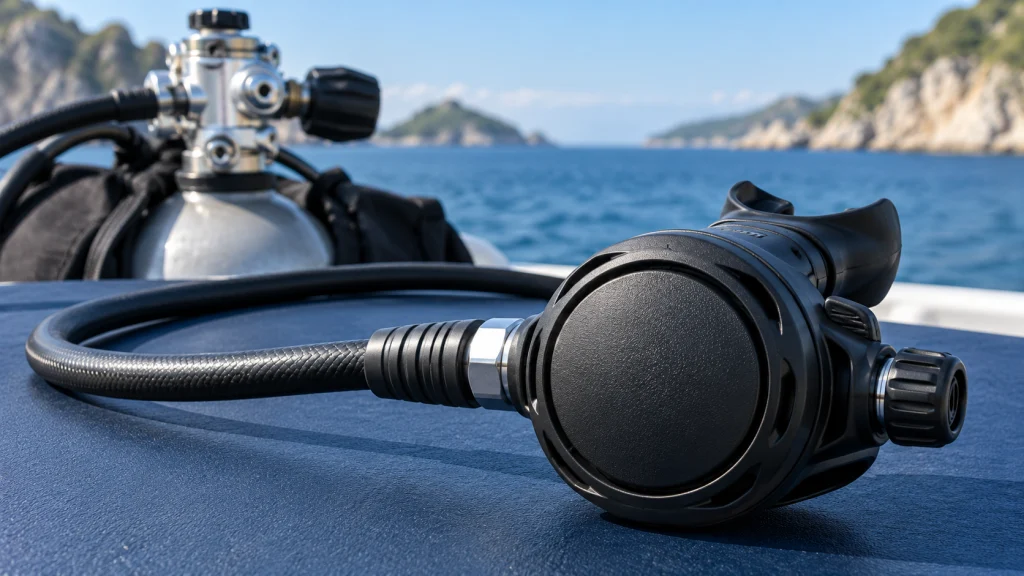
The second stage is the component from which the diver breathes through a mouthpiece. It is often called a demand valve because it supplies gas in response to inhalation. Its operation relates to the pressure of the surrounding environment, while the first stage provides the supply it is designed to receive.
A mouthpiece, front cover, purge control and exhaust arrangement are common visible features, but their details differ. Some models have additional user controls; others are simpler. Learn the controls of the actual unit with an instructor and the manual. Do not assume a knob has the same function or direction of adjustment as one on a different regulator.
The alternate air source has a defined role
Many recreational configurations include an alternate second stage, while other approved systems use a different arrangement. Its placement, identification and use should follow the relevant instruction and configuration. A bright color is a visual cue, not a substitute for the buddy understanding where the alternate source is and how it is intended to be used.
Check what a retailer package includes. The main breathing regulator may be sold without an alternate source, gauge or inflation hose. Do not describe a set as complete until the necessary components for the intended configuration are identified. Discuss the full setup with the instructor or operator rather than treating one supplied second stage as the entire system.
BCD and drysuit inflation connections
The first stage can supply suitable low-pressure inflation components in addition to the breathing second stages. A BCD inflator and a drysuit system have their own compatibility requirements, controls and training. A hose physically reaching an attachment point does not establish the correct connection or operating arrangement.
Consider the number and layout of approved ports when evaluating a regulator. The requirement comes from the planned configuration, not from a desire to use every available port. Avoid adding hoses or adapters without a defined role and qualified confirmation. The complete setup should support appropriate routing, access and familiar handling.
Piston and diaphragm describe first-stage designs
Piston and diaphragm are terms for different first-stage mechanisms. They are useful when reading specifications, but the broad category does not establish how every individual model performs, what environment it supports or what servicing it needs. Manufacturers offer multiple designs with different features and approvals.
Do not reduce the purchase to a universal statement that one mechanism is always better. Check the exact system’s environmental rating, gas compatibility, service support and suitability for the planned diving. A clear explanation from an authorized shop is more useful than treating a design label as a measured performance ranking.
Balanced descriptions need their own context
The word “balanced” may appear in descriptions of first stages, second stages or the complete package. It concerns a design characteristic, rather than a guarantee that breathing effort will be identical in every condition. Read which component the manufacturer is describing and what the published claim actually says.
GearDeep does not assign independent breathing-performance scores without testing. If a comparison cites a certification or manufacturer figure, it should identify the precise product and conditions. Your equipment still needs the correct combination of components, maintenance and appropriate use. A higher-positioned product in a range does not remove those requirements.
DIN and yoke are connection choices
DIN and yoke describe different ways the first stage connects to the cylinder valve. They do not describe the breathing second stage or the cylinder’s neck thread. Choose a system compatible with the cylinders and pressures used by the relevant facility, and obtain qualified advice on any approved adapter arrangement.
Our DIN versus yoke guide separates those interfaces. Do not attempt a valve conversion or regulator modification because a general article says adapters exist. Compatibility involves the exact hardware and operating specification, and an apparently secure physical connection is not proof that a system is approved.
Gas and temperature compatibility
Read the manufacturer’s limits for the actual regulator system and intended gas. A claim made for another model, another market or one component should not be transferred to the full assembly. Oxygen-related requirements and cold-water suitability can involve specific approved configurations and professional preparation.
Do not turn a material or environmental-seal feature into permission for diving outside your training. Tell the supplier what you intend to do and ask for the relevant documentation. If the source is unclear or the package contains mixed components, resolve that uncertainty before the equipment enters service.
Mouthpiece fit and hose layout
Comfort depends on the complete arrangement. A mouthpiece that pulls awkwardly may be affected by fit, routing or other equipment interaction. Do not compensate by biting unusually hard or accepting persistent discomfort. Have the setup reviewed appropriately and use supported replacement parts where changes are needed.
Hose routing should preserve access and avoid the problems addressed in your training. Changing a first stage’s body layout or a second stage’s attachment can alter a familiar arrangement. Check the configuration after approved changes, and familiarize yourself in suitable controlled conditions before relying on it during more demanding diving.
Care is different from servicing
Owner care includes the cleaning, drying, protection and inspection described by the manufacturer. Keep water out of areas the instructions identify and do not press controls or immerse components contrary to the prescribed method. A dry dust cap and protective storage are useful only as part of the correct routine.
Internal servicing and adjustment require the appropriate qualified facility. Follow the current model-specific schedule and seek assessment sooner if the regulator leaks, behaves unusually or is damaged. A clean exterior cannot establish the condition of internal parts. Keep service records with the exact model details so the history remains understandable.
Identify what a service record covers
Keep the model details for both stages in the equipment record. If a shop services the first stage but a second stage was supplied separately, confirm the scope of the work rather than assuming the entire assembly was included. The same applies to an alternate source, gauge and inflation components. Clear records help the next technician understand what was inspected, changed or left for another appointment.
Use the names to improve the pre-dive check
Knowing which part is the first stage, which is the primary second stage, and where the alternate source and pressure indication sit makes the buddy discussion clearer. It does not replace the functional checks taught during training. Review the actual equipment used that day, especially when renting or changing a component.
PADI’s regulator overview introduces those roles. Use it with your manual, qualified assembly and the pre-dive equipment checklist. The useful outcome is a familiar, supported system whose function you understand, rather than confidence based only on knowing the terminology.
About the author
Robert
Robert writes about scuba-diving equipment for GearDeep, focusing on fit, compatibility and the practical differences between products. His buying guides use manufacturer specifications and manuals to help readers compare their options, understand important limitations and make informed equipment choices.