
By Robert · Updated
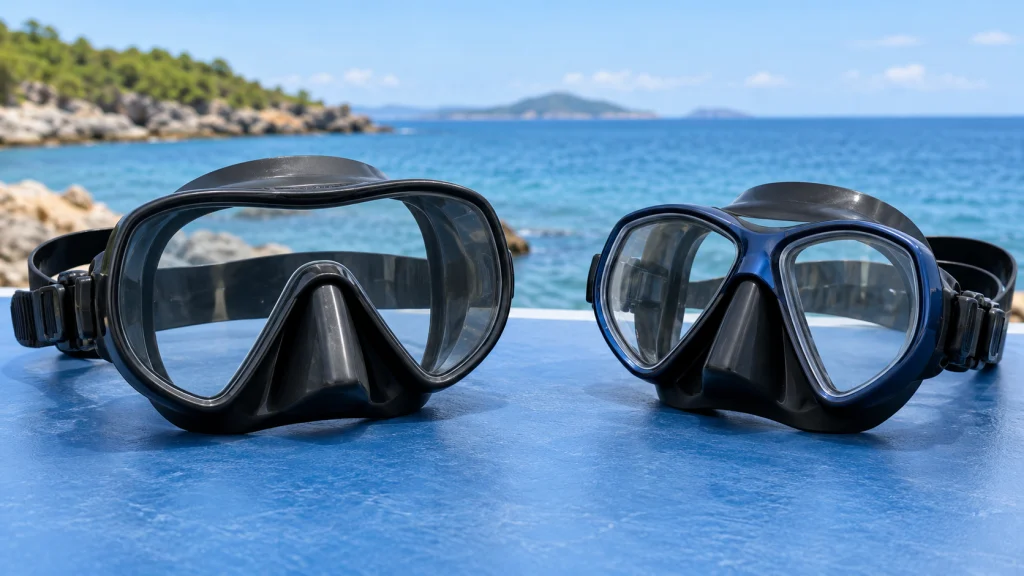
The single lens vs dual lens scuba mask decision concerns lens layout, frame shape and corrective-lens options. It does not tell you which mask will seal on your face or give you the widest useful view. A single-lens mask has one continuous front window; a dual-lens mask has separate windows for the two eyes. Start with facial fit and vision needs, then compare the complete masks. The number of front lenses is one feature in that decision, rather than a quality ranking.
What the lens count actually describes
On a conventional single-lens mask, the front glass spans both eyes without a central frame bridge dividing the viewing window. The nose still occupies its own pocket below that window. In a dual-lens design, the two lenses sit in a frame with a bridge between them. The arrangement can affect the frame’s dimensions, how the lenses sit near the eyes and which replacement systems are possible.
Neither description specifies the volume of the mask, the softness of its skirt or the quality of the buckles. A compact framed mask and a compact frameless mask may share some practical characteristics despite different lens counts. Compare the exact construction instead of assuming every mask in one group behaves alike.
The first test remains the skirt seal
A mask needs a skirt shape that lies comfortably against your face. Lens layout cannot correct a skirt that lifts near the temples or pinches around the nose. Try more than one shape, using the dry fitting procedure taught by a knowledgeable shop or instructor. Lightly checking the seal is useful; strong suction is not proof that the mask will work comfortably underwater.
After adjusting the strap as instructed, assess the fit with your regulator mouthpiece in place. Facial shape can change slightly when the mouthpiece is held. Include your hood where applicable. If a single-lens model fits comfortably and a dual-lens model leaks, that is a reason to prefer that particular single-lens mask, not evidence that one layout is universally better. Our mask fitting guide covers that evaluation in more detail.
Understand the central bridge trade-off
A continuous window avoids the visible central bridge found in many dual-lens masks. Some divers prefer that visual impression. Others are barely aware of the bridge once the mask is fitted. The effect depends on where the frame sits relative to your eyes and how you naturally look through it. A product photograph taken from outside the mask cannot establish what you will notice.
Look straight ahead, then toward the equipment you need to read. Avoid deciding from a short glance in a mirror. The practical question is whether the frame interferes with useful viewing directions, not whether the mask looks open from the front. Try the models while wearing the same exposure equipment so the comparison is meaningful.
Viewing area is not the same as useful visibility
A large lens does not automatically provide the most useful field of view for every face. Lens position, angle, distance from the eyes, skirt geometry and the shape of the frame all influence what you can see. These factors also affect how easily you look down toward an instrument or sideways toward a buddy.
Treat broad marketing descriptions as reasons to try a mask, rather than measurements that apply to your face. If the manufacturer publishes a viewing claim, check what it actually describes. Do not compare an advertised angle from one brand with a different brand’s unspecific “panoramic” label as though they came from the same test. Your own controlled fit assessment should settle whether the layout is useful to you.
Corrective lenses can change the shortlist
Some dual-lens masks accept model-specific replacement optical lenses. Separate lenses can allow different corrections on the two sides when the system supports them. That does not mean every dual-lens mask offers this option. Verify the exact mask, lens part numbers, available corrections and installation requirements before ordering the frame.
A single-lens mask may have a different route to optical correction, such as a compatible professionally supplied system, but this also requires exact confirmation. Avoid buying first and assuming a generic insert will fit later. If you need vision correction for diving, discuss the options with a qualified eye-care professional and a supplier familiar with the mask. The commercial term “prescription compatible” is not enough information by itself.
Frame construction deserves a separate comparison
Lens count and the presence of a rigid frame are related design choices, but they are not interchangeable terms. “Frameless” commonly describes a construction in which the skirt is bonded around the lens without a conventional external frame. It does not mean the lens is flexible or that the complete mask can be folded without limits.
A framed design may allow particular components to be replaced, while another mask may require replacing the assembly. Ask what the manufacturer actually supports. Repairability can matter if you travel to places where a replacement strap is easy to find but an unusual frame component is not. Do not try to disassemble a mask simply because another model has user-replaceable lenses.
Internal volume and clearing
Internal volume is the space enclosed between the mask and your face. It is influenced by skirt shape and lens position, rather than by lens count alone. A low-volume description should therefore be checked for the complete model. A mask that sits close to one face may sit differently on another.
Mask clearing and equalization are skills learned in training. A particular layout does not remove the need to practice those skills with the equipment you will use. If you change to a mask with a different fit or volume, become familiar with it in suitable controlled conditions. Persistent difficulty is a reason to seek instructor help and review fit, rather than to keep tightening the strap or buy solely from a volume label.
Test nose-pocket access with your actual equipment
Both styles must give you appropriate access to the nose pocket for the techniques taught during training. Check with the gloves and hood you normally wear. A frame bridge or lower lens edge that seems unobtrusive with bare hands can feel different once bulky exposure protection is added.
Also notice any contact at the bridge of the nose, brow or cheekbones. A firm edge should not create a painful pressure point. These checks concern the complete shape of the mask. If one dual-lens model presses on the nose, try a different shape before concluding that all dual-lens masks will do the same. The same reasoning applies to a wide single-lens frame.
Clear and dark skirts are another decision
Skirt color changes the experience independently of the lens arrangement. Clear material admits light from the sides; dark material limits that light. Preferences vary, including among photographers who care about reflections and divers who like an open visual impression. A dark skirt is not automatically more suitable for advanced diving, nor does a clear skirt establish better awareness.
When comparing lens layouts, try to keep skirt color similar where possible. Otherwise you may attribute a change in ambient light to the front-window design. Explain to the shop what you liked or disliked about a previous mask. That feedback is more useful than a broad request for “the best dual lens” or “the biggest single lens.”
Lens coatings and tinted variants
Surface treatments can affect glare, appearance and care requirements. They also vary between versions of what appears to be the same model. Confirm whether the mask in the retailer’s photograph is the exact lens treatment you intend to buy. Do not infer a medical benefit or improved underwater performance merely from a colored reflection on the glass.
Read preparation instructions before applying an abrasive cleaner, toothpaste or heat. A method repeated online for ordinary glass may be unsuitable for a coated lens. The same warning applies to both lens layouts. Our mask care article explains how to separate ordinary rinsing from treatment-specific preparation without assuming one cleaning method works for every mask.
Compare travel and backup use fairly
A mask’s packed size includes its frame, skirt and suitable protective case. A frameless single-lens mask can sometimes be compact, but that does not establish the size of every model. A smaller dual-lens design may fit your storage arrangement better. Use actual dimensions and check how the mask sits in the case or pocket you plan to use.
A backup mask still needs to fit, provide useful vision and be compatible with the planned configuration. Buying a poorly fitting model because it packs flat defeats its purpose. Practice any equipment use according to your training, and make sure storage does not expose the lenses to grit or permanently deform the skirt.
A useful shop comparison
Shortlist masks that meet your optical needs, then compare fit without letting lens count decide the result in advance. Wear each for long enough to notice pressure points, check the seal with your mouthpiece, and look in the directions required to read your instruments. Test adjustment controls with the gloves you use. Confirm replacement parts and return conditions before making the purchase. Our scuba mask buying guide groups six designs by lens arrangement and documented optical options for a more focused fitting.
Choose the model that brings those requirements together. PADI’s mask overview identifies fit, nose access and optical options as relevant selection considerations. Lens layout helps describe the equipment, but comfort and useful vision determine whether the particular mask deserves a place in your kit.
About the author
Robert
Robert writes about scuba-diving equipment for GearDeep, focusing on fit, compatibility and the practical differences between products. His buying guides use manufacturer specifications and manuals to help readers compare their options, understand important limitations and make informed equipment choices.